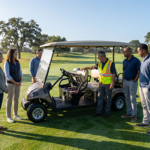
Golf carts have outgrown the golf course — and the industry data proves it’s no accident.
What began as a simple 2-seater convenience vehicle for aging golfers has steadily transformed into a cornerstone of modern group mobility infrastructure. Today, every forward-thinking golf cart manufacturer is designing for resorts, gated communities, airports, campus environments, and large-scale event venues — not just fairways. The vehicle category has fundamentally changed, and so have the demands placed on it.
The global golf cart market is projected to reach $2.55 billion by 2030, according to Allied Market Research, driven overwhelmingly by the hospitality sector and the explosive growth of planned residential communities. These environments share a common challenge: moving groups of people efficiently across defined, controlled spaces without the cost or infrastructure burden of full-size vehicles.
Traditional 2- and 4-seater carts, however, were never designed for this scale. In high-traffic settings, their limitations become operational liabilities:
- Capacity bottlenecks — Moving a family of six or a resort tour group requires multiple vehicles and multiple trips.
- Fleet sprawl — More carts mean more maintenance, more charging stations, and more management overhead.
- Passenger comfort gaps — Narrow frames and minimal suspension perform poorly when guests expect a premium experience.
This is precisely where the wide-body design concept enters the conversation. Purpose-built 8-seater platforms prioritize structural width for stability, improved weight distribution, and the kind of interior comfort that matches a hospitality brand’s standards. Modern 8-seater configurations reflect a deliberate engineering shift — away from stripped-down utility and toward passenger-grade functionality.
The result is a vehicle that doesn’t merely supplement existing transport — it replaces the need for an entire small fleet. Understanding why that matters starts with the math behind moving eight people at once versus managing four separate 2-seater carts.
The Logistics of Group Transport: Why 8 Seats Outperform Four 2-Seaters
Replacing a fleet of smaller carts with a single high-capacity vehicle isn’t just a convenience upgrade — it’s a measurable operational advantage that affects costs, maintenance, and guest satisfaction simultaneously.

The math alone makes the case. Moving eight guests in one wide body golf cart eliminates the coordination burden of dispatching, staging, and timing four separate 2-seaters. In practice, that means fewer driver hours, fewer departure delays, and a dramatically simpler logistics chain for facility staff. One vehicle, one driver, one departure window.
The operational benefits extend well beyond scheduling. Consider what four carts actually require versus one:
- Maintenance overhead: Four sets of tires, motors, brake assemblies, and suspension components versus one — routine service costs drop significantly
- Charging cycles: A single battery bank, managed on one predictable charge schedule, reduces energy waste and battery degradation compared to coordinating four independent units
- Fleet tracking: One vehicle to locate, inspect, and log per trip rather than four, simplifying staff accountability and end-of-day checks
- Operator licensing and training: Fewer drivers needed per transport event, reducing staffing complexity during peak hours
- Insurance and registration costs: One unit on the books instead of four separate entries
Energy efficiency is a compelling factor. According to the U.S. Department of Energy, consolidating multiple transport cycles into a single high-efficiency run meaningfully reduces the carbon footprint of resort and campus operations — a growing priority for facilities with sustainability commitments.
The guest experience dimension is equally important. Unified group travel keeps wedding parties together, keeps tour groups synchronized, and eliminates the awkward “split group” problem where half the guests arrive minutes apart. That cohesion signals operational professionalism. For facilities weighing whether high-capacity transport qualifies as street-legal infrastructure, understanding how carts are classified legally is an important parallel consideration.
All of this efficiency, of course, depends on the vehicle itself being engineered to handle the load reliably — which raises a critical question about how these carts are actually built to carry eight passengers safely.
Engineering Stability: The Critical Role of Rear-Wheel Drive in Multi-Passenger Carts
Stable, predictable handling in 8 seater golf carts depends less on driver skill and more on the mechanical architecture built into the frame from the ground up.
Rear-Wheel Drive (RWD) is not a luxury feature in multi-passenger carts — it’s a load-management necessity. When eight adults occupy a cart simultaneously, the combined weight can exceed 1,200 lbs. In that scenario, a front-wheel-drive system struggles to maintain traction because the driven axle is working against the natural rearward shift of that load. RWD aligns the drive force with where the mass actually sits, giving the powertrain a mechanical advantage that translates directly into confident, responsive acceleration.
Weight distribution becomes especially nuanced in a 6+2 seating configuration, where the rear-facing “plus-two” jump seats extend beyond the rear axle. This overhang creates a pendulum effect at speed. High-quality manufacturers counter this by:
- Extending the Wheelbase to spread load across a longer frame
- Lowering the center of gravity through chassis design
- Calibrating suspension stiffness to resist body roll during turns
These engineering choices prevent the dreaded “fishtail” effect — the lateral instability that occurs when rear mass oscillates on a long-frame vehicle during cornering. In practice, a properly engineered extended-wheelbase cart corners with far less sway than its dimensions might suggest. Understanding how manufacturers approach these dynamics is worth exploring across different cart configurations and specs before making a purchasing decision.
Braking systems on heavy-duty multi-passenger models must scale proportionally with that added mass. Hydraulic disc brakes or four-wheel drum systems are common at this capacity level, providing the stopping force needed when a fully loaded cart descends a ramp or navigates a crowded venue. Single-axle braking — standard on smaller 2-seaters — is simply inadequate at eight-passenger gross weights.
The structural engineering behind stability naturally raises a related question: what kind of power system is actually driving all of that weight forward? That conversation starts with voltage.
72V Power Systems: Decoding Speed and Torque for Heavy Loads
A 72V power system isn’t just an upgrade over lower-voltage alternatives — it’s the engineering threshold that makes reliable 8-passenger transport genuinely practical.
So, how fast will a 72V golf cart go? In standard configuration, a 72V golf cart speed typically tops out between 19 and 25 mph, depending on motor tuning, load weight, and terrain. That range is intentional — it balances performance with the safety demands of carrying a full passenger load.
Voltage, torque, and capacity are directly linked. Higher voltage means more power delivered to the motor without excessive heat or amperage draw. For an 8-seater carrying up to 1,200–1,600 lbs of combined passenger and cargo weight, that low-end torque is non-negotiable. A 48V system strains under that demand; a 72V system handles it with headroom to spare.
Why has 72V become the de facto standard for high-capacity models? Three reasons stand out:
- Sustained hill-climbing ability — torque doesn’t drop off on inclines under full load
- Motor longevity — lower amperage at higher voltage reduces heat stress on windings
- Battery cycle efficiency — charge energy distributes more evenly across the pack, extending overall lifespan
Before modifying any wiring on a multi-battery pack, it’s worth understanding how voltage tapping creates problems — an often-overlooked issue that affects reliability in real-world use.
The efficiency case is compelling. According to the Office of Energy Efficiency & Renewable Energy, electric vehicles can achieve energy efficiency exceeding 85%, compared to less than 25% for internal combustion utility vehicles. For operators running daily shuttle routes or resort loops, that gap translates directly into lower operating costs.
For a real-world demonstration of 72V performance under load, see the video below:
[EMBED: https://www.youtube.com/watch?v=dPhzr6m6XMA]
That efficiency advantage becomes even more significant when you consider how 8-seaters are increasingly being deployed far beyond golf courses — a shift that points toward something larger happening in urban and campus mobility.
The Sustainability Factor: Multi-Passenger Carts as Last-Mile Solutions
Multi-passenger electric carts are no longer a novelty — they’re becoming essential infrastructure for campuses, municipalities, and smart cities serious about reducing their carbon footprint.
The LSV shift is accelerating. Municipalities across the U.S. are updating local ordinances to welcome street-legal Low-Speed Vehicles as legitimate transport options. When equipped with standard safety features — headlights, turn signals, mirrors, and seatbelts — 8-seater carts can operate legally on roads posted at 35 mph or below, opening up entirely new use cases beyond private property. (Buyers navigating compliance requirements will find LSV equipment details particularly useful when outfitting carts for public road use.)
The last-mile problem is real. Eco-conscious campuses, hospitals, and transit hubs consistently struggle with that final quarter- to half-mile gap between a drop-off point and a destination. A single 8-passenger electric cart can shuttle a full group in one trip, eliminating the need for multiple gas-powered vehicles or personal cars idling near building entrances.
“The shift toward street-legal Low-Speed Vehicles (LSVs) is transforming urban mobility, with multi-passenger electric carts becoming the preferred ‘last-mile’ solution.” — International Journal of Sustainable Transportation
Noise reduction is an underrated benefit. In hospitality environments, residential communities, and healthcare campuses, the near-silent operation of electric drivetrains meaningfully improves ambient quality of life. Unlike gas-powered shuttles, electric carts produce virtually zero engine noise — a practical win that’s hard to quantify but immediately noticed.
Smart City planners are paying attention. High-capacity electric transport fits naturally into integrated urban mobility networks, where data-driven routing, zero-emission zones, and shared vehicle fleets work together. An 8-seater occupies the critical middle ground — too small to require a CDL driver, yet large enough to move groups efficiently.
With the sustainability case firmly established, the next logical question becomes how these vehicles are actually built for the people riding in them — and that’s where design decisions make all the difference.
Design and Comfort: The ‘Wide Body’ Advantage for Passenger Experience
Modern high-capacity group transport lives or dies on passenger experience — and wide body design is the engineering detail that separates genuinely comfortable rides from cramped, begrudging ones.
A wide body golf cart isn’t simply a standard cart with extra rows bolted on. It’s a fundamentally different chassis geometry, engineered with a broader track width that distributes passenger weight evenly and, as Varyon Machinery’s product design principles confirm, provides the lateral stability essential for carrying eight passengers through turns without unsettling sway.
Ergonomics are where this geometry pays dividends in practice. Key passenger-focused design elements typically include:
- Generous legroom between rows, preventing the knee-to-back-of-seat compression common in narrow configurations
- Low, wide entry/exit points that allow passengers of varying mobility to board and disembark without awkward climbing
- Integrated safety rails and grab handles positioned at natural reach height for standing passengers during boarding
These aren’t minor conveniences — they’re the difference between guests arriving relaxed and arriving rattled.
Customization is where premium facilities truly differentiate their fleet. Models like the VY-D6+2 support a range of upfitting options that transform utilitarian transport into a branded hospitality statement: extended roof canopies for weather protection, premium UV-resistant upholstery in resort color palettes, soft-touch armrests, and even integrated USB charging ports for guest convenience.
Psychological impact deserves acknowledgment here. Research in hospitality consistently shows that first and last touchpoints define overall guest perception. Arriving at a luxury resort in a thoughtfully designed, whisper-quiet cart — versus a dated, rattling alternative — sets an immediate emotional tone. The vehicle becomes part of the experience, not merely a means to an end.
As facilities evaluate these design considerations, the natural next question becomes equally important: which specific model and configuration best matches operational scale and guest volume? That selection process involves its own set of practical criteria worth examining closely.
Strategic Implementation: Choosing the Right 8-Seater for Your Facility
Selecting the right high-capacity electric cart is a procurement decision with long-term operational consequences — one that rewards careful evaluation over impulse purchasing.
The manufacturer’s certification record is your first filter. Build quality varies significantly across the market, so prioritize suppliers who meet recognized safety and electrical standards, carry verifiable quality management certifications, and demonstrate a clear after-sales service infrastructure. A cart that fails under daily operational load doesn’t just create downtime — it creates liability.
Buyer Considerations Checklist:
- Certifications — Confirm CE, UL, or equivalent electrical and structural compliance before shortlisting any model
- Seating configuration — Evaluate whether a 6+2 layout or a standard flat 8-row arrangement better fits your boarding flow and passenger mix
- Battery system — Assess lithium battery warranty terms, cycle life ratings, and whether the manufacturer supports cell-level diagnostics
- Drive system — Rear-wheel drive is non-negotiable for safe handling at gross vehicle weight capacity (as covered in earlier sections)
- Parts availability — Confirm that replacement components are stocked regionally, not shipped internationally on a 6–8 week lead time
- Terrain compatibility — Match tire spec and ground clearance to your actual operating environment; for mixed-surface facilities, a cart built for rougher ground may outperform a road-optimized model
On the 6+2 vs. standard 8-row question: The 6+2 configuration — as engineered in the VY-D6+2 — uses a forward-facing primary cabin of six with a rear-facing two-seat section. According to Varyon Machinery, this arrangement maximizes passenger capacity while keeping the vehicle footprint manageable. In practice, it also improves boarding efficiency in high-throughput environments like airport terminals or resort drop-off zones.
Lithium maintenance is leaner than lead-acid but not zero-effort. Battery management systems require periodic software checks, and thermal performance should be monitored in extreme climate conditions.
The VY-D6+2 consolidates these considerations into a single vetted platform — which is why the numbers behind that decision deserve a closer look before drawing any final conclusions.
The Bottom Line: Key Takeaways for High-Capacity Mobility
High-capacity electric carts have moved well beyond novelty status — they’re now a strategic infrastructure choice that delivers measurable returns across safety, sustainability, and operational efficiency.
Throughout this article, the case has built steadily: wide-body design improves passenger comfort, 72V powertrains handle real-world multi-passenger loads, and procurement decisions carry long-term consequences. Here’s what that all distills down to:
- Fleet consolidation drives serious ROI. Replacing multiple smaller carts with 8-seater units like the VY-D6+2 isn’t just a logistics simplification — it’s a financial win. Consolidating transport into high-capacity units reduces total charging cycles and maintenance touchpoints by up to 60%, according to industry efficiency analysis. Fewer vehicles mean fewer batteries, fewer service intervals, and less overhead.
- 72V systems aren’t optional — they’re essential. A 48V drivetrain under a fully loaded 8-passenger frame is an engineering mismatch. 72V systems deliver the torque headroom necessary for consistent, safe acceleration across varied terrain, grades, and load conditions. For facilities managing high daily throughput, this isn’t a premium upgrade — it’s a baseline requirement.
- Rear-wheel drive is a non-negotiable safety feature. In large-frame carts, rear-wheel drive keeps weight distribution balanced under full passenger loads, reducing the risk of front-end understeer and improving overall handling stability. If you’re evaluating options, this is a specification worth verifying — similar to how the dual-axle configuration on smaller platforms demonstrates what proper weight management looks like even at reduced capacity.
- The shift to high-capacity electric transport reflects a broader institutional commitment. Facilities that adopt this model aren’t just upgrading a fleet — they’re signaling a long-term alignment with sustainable, efficient operations. High-capacity electric mobility is increasingly a cornerstone of responsible facility management.

These takeaways cover the strategic fundamentals — but operational questions often get more granular. If you’re still working through specifics like speed ratings, range estimates, or street-legal requirements, the next section addresses the most common questions buyers ask before finalizing a decision.
Frequently Asked Questions About 8-Seater Golf Carts
Eight-seater golf carts raise practical questions that deserve direct, technically grounded answers before any procurement decision is finalized.
How fast will a 72V golf cart go?
Most 72V electric golf carts are governed to speeds between 19–25 mph for safety and LSV compliance. The voltage upgrade over standard 36V or 48V systems delivers more torque and improved hill-climbing ability, but top speed is typically limited by the controller settings — not the battery alone. Operators can often adjust the governor within manufacturer-approved ranges, though exceeding posted LSV limits creates liability exposure.
Can an 8-seater golf cart be made street legal?
Yes — but the path requires deliberate preparation. Street-legal conversion demands specific equipment: headlights, taillights, turn signals, mirrors, a windshield, seat belts, and a vehicle identification number (VIN). Regulations vary by state and municipality, so verifying local ordinances before purchasing is essential. Some 8-seater models ship LSV-ready from the factory, which simplifies the compliance process considerably.
What is the average range of a 72V 8-seater on a single charge?
In practice, a fully loaded 72V 8-seater typically delivers 25–40 miles per charge under normal operating conditions. Range shrinks with full passenger capacity, hilly terrain, frequent stops, and accessory loads like lighting or climate fans. Fleet managers planning multi-loop shuttle routes should treat 25 miles as a conservative planning baseline and factor in opportunity charging during shift breaks.
How does rear-wheel drive improve handling in multi-passenger vehicles?
Rear-wheel drive distributes braking and steering forces more effectively when carrying heavy, distributed loads. In multi-passenger carts, weight concentration shifts rearward — a dynamic that rear-wheel drive systems are inherently better suited to manage. The result is more predictable cornering, reduced front-end understeer, and improved traction on inclines. For resort paths, campus routes, or uneven event grounds, this handling advantage translates directly into passenger comfort and driver confidence.