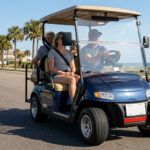
In Florida communities like The Villages or the coastal enclaves of California, local police are increasingly handing out $500 fines for a simple mistake: driving a standard cart on a public road. The owners usually think they bought a “street-legal” vehicle, but in the eyes of the law, it’s just a golf cart. In 2026, understanding the Golf Cart vs LSV distinction is the difference between a smooth commute and an impounded vehicle.
Table of Contents
The Speed Barrier: 20 MPH Changes Everything
The first gatekeeper in the Golf Cart vs LSV debate is design speed. According to the FMVSS 500 standards managed by the NHTSA, any four-wheeled vehicle designed to travel between 20 and 25 mph is classified as a Low-Speed Vehicle (LSV).
Standard carts are legally capped at 15 mph. The moment you “unlock” a controller to push past 20 mph, the vehicle undergoes a legal transformation. The hard proof of this change is the 17-digit VIN. An LSV must have a unique identification number assigned by the manufacturer and recorded with the DMV. If your vehicle only has a short factory serial number, it is legally barred from public streets.
Hardware Realities: Why Plastic Windshields Fail the Test
Many owners attempt a street legal golf cart conversion by just adding lights and a horn. However, federal law for LSVs is far more demanding. Compliance isn’t about “working”; it’s about meeting Department of Transportation (DOT) industrial standards.
When checking minimum safety equipment for street legal LSVs, the windshield is the primary failure point. Standard carts use folding acrylic or plastic windshields that shatter into dangerous shards on impact. A compliant LSV requires AS-1 or AS-4 automotive safety glass. Furthermore, you must have three-point seat belts and a dedicated mechanical parking brake—not just a click-lock on the floor pedal.
Road Access: The 35mph Hard Ceiling
The core of the Golf Cart vs LSV controversy usually centers on “where can I actually drive?” This is a matter of right-of-way. Standard carts are generally restricted to golf courses or specific “Cart Paths” designated by local ordinance.
So, Can I drive my golf cart on a 35mph road? The answer is almost always No. Even in cart-friendly zones, you are prohibited from traveling on public roads with speed limits exceeding 25 mph. In contrast, a registered LSV has the legal right to operate on public roads with speed limits of 35 mph or less. This allows you to legally cross town to a gas station or restaurant, provided you stay off major highways.
Core Comparison: Carrinho Golfe vs LSV Technical Specs
| Feature | Standard Golf Cart | Low-Speed Vehicle (LSV) | Key Takeaway |
| Top Speed | < 15 mph | 20 – 25 mph | Legal dividing line |
| Identification | Serial Number | 17-digit VIN | Required for tags |
| Windshield | Acrylic / Folding | AS-1 Safety Glass | Must be DOT-stamped |
| Seat Belts | Optional / 2-Point | Mandatory 3-Point | Critical for safety |
| Road Access | Restricted Cart Paths | Roads up to 35mph | True mobility freedom |
The Insurance Gap: A Mandatory Upgrade
Budgeting for the Golf Cart vs LSV transition requires looking past the purchase price. Standard golf cart insurance is cheap, often added as a “rider” to a homeowners policy for less than $100 a year.
However, verified data on Golf cart vs LSV insurance cost 2026 shows that because LSVs are registered motor vehicles, you must buy a standalone auto policy. This includes Personal Injury Protection (PIP) and Property Damage Liability (PDL). In Florida or California, expect to pay between $400 and $700 annually. While expensive, this coverage is your only shield if you are ever hit by a full-sized SUV—a scenario where a homeowners policy would leave you completely exposed.
Florida Field Guide: Getting the Metal Plate
Meet the NEV: More Than Just a Caddy
In your Golf Cart vs LSV research, you will likely encounter the term Neighborhood Electric Vehicle (NEV). Essentially, an NEV is just a marketing name for an LSV designed for community commuting rather than sport.
In 2026, the shift toward lithium (LiFePO4) technology in the Neighborhood Electric Vehicle (NEV) space has made these cars much more viable. They now offer 40+ miles of range and automotive-style features like backup cameras and GPS, making the “around town” utility far superior to a lead-acid golf cart.
Expert Warning: The Dangers of “Software Hacks”
Some dealers offer a street legal golf cart conversion by simply tweaking a controller setting to increase speed. This is a massive risk. If the mechanical hardware—specifically the brakes and windshield—isn’t upgraded to match the speed, the vehicle is a rolling liability. In the event of an accident, an insurer will check the VIN; any illegal modification without a state-certified inspection will result in a denied claim.
Final Verdict: Choose the Right Lane
The battle of Carrinho Golfe vs LSV is ultimately a choice between a “recreation tool” and a “transportation tool.” If your life stays strictly on the greens, a standard cart is fine. But if you want to visit a cafe, pick up groceries, or pick up the grandkids, a street-legal LSV is the only legal path.
Perguntas frequentes
Can I drive an LSV without a license?
No. Since an LSV is a registered motor vehicle, the driver must possess a valid driver’s license.
Why is AS-1 safety glass mandatory for LSVs?
Road debris is much more dangerous than golf ball impacts. Standard acrylic windshields shatter into shards, while AS-1 glass is designed to stay intact.
Do I need a license plate for my LSV?
Yes. Unlike a golf cart, an LSV must be titled, registered, and tagged with a state-issued license plate.
Can I take an LSV on the highway?
No. LSVs are strictly prohibited from any road with a speed limit over 35 mph, even if the vehicle is capable of higher speeds.