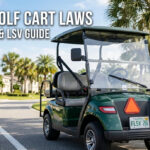
The transition from a standard golf cart to a compliant Low-Speed Vehicle (LSV) is a technical process that requires more than a few bolt-on accessories. While many owners start by simply adding mirrors, achieving a golf cart street legal designation requires adhering to specific federal and state-level safety standards. This guide breaks down the essential hardware, the electrical logic, and the administrative hurdles involved in a professional-grade DIY conversion.
Table of Contents
The Baseline: Federal FMVSS 500 Standards
Before turning a single wrench, you must understand the federal framework. The National Highway Traffic Safety Administration (NHTSA) classifies road-legal carts as LSVs under Federal Motor Vehicle Safety Standard No. 500 (FMVSS 500). To reach the golf cart street legal benchmark, the vehicle must be capable of reaching at least 20 mph but not exceeding 25 mph.
For a successful DIY LSV Conversion, your hardware must meet these minimum requirements:
- Headlamps, front and rear turn signals, and tail lamps.
- Stop lamps (brake lights).
- Reflex reflectors (one red on each side and one on the rear).
- An exterior mirror on the driver’s side and either an interior rearview mirror or a passenger-side exterior mirror.
- A parking brake.
- A windshield that meets the glazing requirements of FMVSS 205 (AS4 or AS5).
- A VIN (Vehicle Identification Number) and a Type 1 or Type 2 seat belt at each seating position.
“According to the National Highway Traffic Safety Administration (NHTSA) under Federal Motor Vehicle Safety Standard No. 500 (49 CFR 571.500), a vehicle must meet specific safety criteria to transition from a standard buggy to a bona fide LSV.”
The Hardware: Installing a Street Legal Light Kit
The most visible part of your build is the illumination system. A standard “off-road” light kit usually lacks the integrated blinker and brake switch functions required by law. When selecting a Street Legal Light Kit, prioritize a plug-and-play harness that includes a steering column-mounted turn signal lever and a brake pad switch.
Proper AS5 Windshield Installation is also a critical legal hurdle. Unlike standard acrylic windshields that can shatter upon impact, AS5-rated acrylic or automotive-grade glass is designed for safety on public roads. This is a non-negotiable component for any Requirements for road legal golf carts in most jurisdictions.
“To ensure your golf cart street legal build passes inspection, each component must comply with DOT and FMVSS 205/209 standards for glazing and seat belt assembly.”
Electrical Backbone: 48V-12V Voltage Reducer and Wiring
One of the most common DIY mistakes is tapping into a single 12V battery within a 48V or 72V pack to power the lights. This causes uneven battery drain and shortens the pack’s lifespan. To do it professionally, you must install a 48V-12V Voltage Reducer. This device takes the full voltage of the battery pack and steps it down to a stable 12V for your accessories.
Following a professional Golf cart brake light wiring guide is essential. The brake switch must be installed on the pedal assembly so that the tail lamps illuminate the moment the pedal is depressed. A clean wiring job involves using automotive-grade looms and heat-shrink connectors to prevent moisture-related shorts, which is vital for long-term golf cart street legal reliability.
Regional Focus: The California CVC Standard
California serves as a benchmark for strict regional compliance. Under California Vehicle Code (CVC) Section 385.5, a “Neighborhood Electric Vehicle” (NEV) must be certified to meet FMVSS 500 standards. If you are modifying a cart to be golf cart street legal in California, the CHP (California Highway Patrol) often requires a physical inspection to verify the presence of all safety features.
Furthermore, CVC Section 21250 restricts these vehicles to roads with a speed limit of 35 mph or less. Even if your DIY project is technically sound, operating on high-speed roads remains a violation. Ensuring your vehicle is golf cart street legal in the Golden State also means registering it with the DMV and displaying a specialized license plate, a process that can be daunting without a proper Certificate of Origin.
Managing Tires and Ground Clearance
Standard knobby tires are often not DOT-approved. For a golf cart street legal build, you must swap these for tires with a “DOT” stamp on the sidewall, indicating they are rated for pavement use. These tires offer better traction on asphalt and contribute to the overall stability of the vehicle at its 25 mph top speed.
| Component | DIY Difficulty | Critical Compliance |
| Brake Light Switch | Moderate | Mandatory for FMVSS 500 |
| Voltage Reducer | Moderate | Essential for Battery Health |
| AS5 Windshield | Easy | Must have DOT Rating |
| DOT Tires | Easy | Required for Inspection |
The Administrative Phase: VIN and Title
Once the mechanical work is complete, you face the paperwork. Many older carts lack a 17-digit VIN. Part of the process of How to make a golf cart street legal DIY involves applying for a state-assigned VIN. This usually requires an inspection where an officer verifies your lights, seat belts, and braking performance. Without this VIN, insurance companies will rarely issue a policy, and the DMV will not issue a plate.
A truly golf cart street legal machine must carry liability insurance. This protects the owner in the event of a collision on public roads. While LSV insurance is generally affordable, the policy must reflect the vehicle’s classification as a road-legal motor vehicle rather than a recreational buggy.
Maintenance and Long-Term Safety
Safety does not end with the inspection. Because these vehicles are lighter than cars, they are more susceptible to component vibration. Regularly checking your golf cart street legal modifications—specifically the tightness of the seat belt anchors and the functionality of the turn signals—is paramount.
Maintaining a golf cart street legal status also means keeping your tires at the correct PSI to ensure the 25 mph speed governor remains accurate. In some states, periodic inspections are required to renew the registration, making preventative maintenance a financial necessity rather than a suggestion.
Conclusion: The DIY Path to Freedom
Taking the DIY route allows for customization and cost savings, but it places the burden of safety entirely on the builder. By following the federal FMVSS 500 guidelines and specific regional laws like the CVC, you can successfully navigate the complexities of a golf cart street legal project. The result is a versatile, eco-friendly vehicle that bridges the gap between the golf course and the local community.
Perguntas frequentes
Is it enough to have a golf cart street legal just by adding lights?
No. You also need an AS4/AS5 windshield, DOT-approved tires, seat belts at every seat, a parking brake, and a 17-digit VIN to meet legal standards.
Can I use a standard car battery for my 12V lights?
While possible, it adds unnecessary weight. It is better to use a 48V-12V Voltage Reducer connected to your main traction battery pack for a cleaner, more efficient installation.
What is the maximum speed allowed for a road-legal cart?
Under federal law, the vehicle must be capable of at least 20 mph but cannot exceed 25 mph to be classified as an LSV.
Do I need a driver’s license for a street-legal cart?
Yes. Once a vehicle is registered for use on public roads, the operator must possess a valid driver’s license and follow all local traffic laws.