Florida remains the national epicenter for neighborhood electric vehicle (NEV) culture. However, the legal landscape governing these vehicles is nuanced. Understanding the current Florida Carrinho Golfe Laws is not just about avoiding fines; it is about ensuring the safety and liability protection of operators, especially in high-density areas like The Villages.
Table of Contents
Defining the Vehicle: Golf Cart vs. LSV
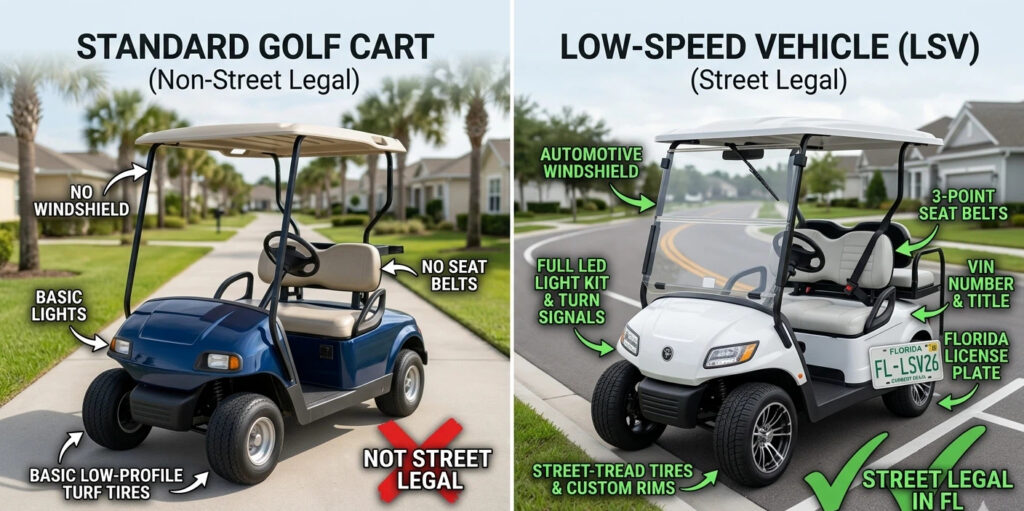
The most critical distinction under Florida Golf Cart Laws is between a standard golf cart and a Low-Speed Vehicle (LSV).
- Standard Golf Cart: Defined by Florida Statute 320.01(22) as a motor vehicle designed for operation on a golf course or for sporting/recreational purposes, not exceeding speeds of 20 mph.
- Low-Speed Vehicle (LSV): Defined by Florida Statute 320.01(41) as a four-wheeled vehicle whose top speed is greater than 20 mph but not greater than 25 mph.
If your vehicle exceeds 20 mph, it is legally classified as an LSV and must comply with more stringent federal and state regulations.
Street Legal Carrinho Golfe FL: Equipment Requirements
To operate a vehicle on designated public roads, you must understand the hardware mandates within Florida Golf Cart Laws. According to Florida Statute 316.212, a standard golf cart only requires:
- Efficient brakes and reliable steering.
- Safe tires.
- A rearview mirror.
- Red reflex reflectorized warning devices on both the front and rear.
However, if you are pursuing LSV registration Florida, your vehicle must meet Federal Motor Vehicle Safety Standard No. 500 (49 CFR 571.500). This includes headlamps, turn signals, taillamps, stop lamps, reflectors, mirrors, a parking brake, a windshield, and a VIN.
The Villages: Driver Age and Licensing
The Villages is the world’s largest golf cart community, but it is not exempt from state-wide Florida Golf Cart Laws. A common point of confusion is the operator’s age.
Do you need a license to drive a golf cart in The Villages FL?
Per Florida Statute 316.212(7), a person must be at least 14 years of age to operate a golf cart on public roads or streets. However, as of late 2023 legislative updates, if the vehicle is being operated by a minor, they must possess a valid learner’s permit or driver’s license. For adults, while a physical license isn’t always required for a standard golf cart on designated paths, having one is highly recommended to avoid complications during traffic stops.
Florida Golf Cart Insurance PIP Requirements
Liability is a significant concern in Florida’s “no-fault” insurance system. While standard golf carts do not technically require insurance under Florida Golf Cart Laws, LSVs are a different story.
Florida golf cart insurance PIP requirements apply strictly to LSVs. Because an LSV is a registered motor vehicle, owners must carry:
- $10,000 in Personal Injury Protection (PIP).
- $10,000 in Property Damage Liability (PDL).
Failure to maintain this coverage can lead to the suspension of your driver’s license, even if the violation occurred in a golf cart.
Roadway Restrictions and Local Ordinances
Under Florida Statute 316.212, golf carts may only be operated on county roads or municipal streets that have been specifically designated for such use. Most Florida Golf Cart Laws prohibit operation on any state road or any street with a posted speed limit above 35 mph.
In communities like The Villages, local ordinances might allow for specific crossings or multi-modal paths. Always check the specific county (Sumter, Lake, or Marion) signage before exiting a residential area.
LSV Registration Florida: The Process
If you wish to convert your cart or buy an LSV, the LSV registration Florida process requires:
1.Form HSMS 82040: Application for Certificate of Title.
2.Proof of Insurance: Meeting the PIP/PDL mandates mentioned above.
3.Sales Tax: Payment of Florida’s 6% sales tax.
4.Inspection: An official inspection at a FLHSMV specialized site to verify the VIN and safety equipment.
Compliance with Florida Golf Cart Laws ensures that your vehicle is titled and plated correctly, protecting your investment and your legal standing.
Frequently Asked Questions
Can I drive my golf cart on a Florida sidewalk?
No. Florida Golf Cart Laws generally prohibit the operation of motorized vehicles on sidewalks unless a local ordinance specifically allows it for safety reasons.
Do I need a license plate for a standard golf cart?
No, standard golf carts are not titled or registered. However, for a street legal golf cart FL (an LSV), a metal license plate is mandatory.
What happens if I get a DUI in a golf cart?
The same Florida Golf Cart Laws and motor vehicle statutes apply. You can be arrested for DUI in a golf cart, which carries the same penalties as a standard automobile.
Are seat belts required for all golf carts?
For standard carts, no. For LSVs (Low-Speed Vehicles), federal law requires three-point seat belts for all occupants.