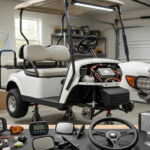
For decades, the heavy, acid-leaking lead-acid battery was the only option for electric vehicles. However, the industry has shifted. A Golf Cart Lithium Battery Conversion is no longer just a luxury; it is a fundamental technical upgrade that redefines the power-to-weight ratio of your machine.
Whether you are navigating the steep hills of a gated community or hauling heavy loads in an industrial warehouse, switching to lithium (specifically LiFePO4) offers consistent voltage, zero maintenance, and a massive weight reduction of nearly 300 lbs.
But this isn’t a “plug-and-play” miracle for everyone. To execute a successful Golf Cart Lithium Battery Conversion, you must understand the synergy between the battery, the BMS, and your speed controller.
Table of Contents
LiFePO4 vs Lead-acid for Golf Carts: The Data Gap
When comparing LiFePO4 vs Lead-acid for golf carts, most users focus on the initial cost. However, a technical analysis reveals that lead-acid batteries suffer from “voltage sag”—as the battery drains, the cart slows down.
Lithium batteries maintain a flat discharge curve. This means your top speed at 20% charge is the same as it was at 100%. Furthermore, lithium cells can handle 3,000 to 5,000 charge cycles, compared to the meager 500 cycles of traditional deep-cycle batteries.
By reducing the vehicle’s weight, a Golf Cart Lithium Battery Conversion also reduces the strain on your suspension and braking systems, effectively extending the overall mechanical life of the chassis.
The energy density gap between chemistries is significant; according to Energy.gov, lithium-ion remains the gold standard for modern EV propulsion.
To truly understand the dramatic performance shift, you need to see the data in action. Watch this technical breakdown comparing the real-time voltage output of LiFePO4 cells versus traditional deep-cycle lead-acid batteries under load.
Matching Your System: High-Torque Motor for Lifted Golf Carts
If you own a modified vehicle, a standard battery won’t cut it. A high-torque motor for lifted golf carts demands high peak discharge currents (Ampere) that cheap lithium packs cannot provide.
When performing a Golf Cart Lithium Battery Conversion on a lifted cart with oversized tires, you must ensure your Battery Management System (BMS) can handle a continuous discharge of at least 200A. Without this headroom, the BMS will “trip” or shut down when you attempt to climb a hill or accelerate rapidly, leaving you stranded.
This technical bottleneck is why we emphasize matching the discharge rate of your new lithium pack to the maximum amp draw of your upgraded controller.
Step-by-Step: How to Install 48V Lithium Battery in Club Car Precedent
The Club Car Precedent is one of the most popular platforms for DIY enthusiasts. Here is a streamlined technical roadmap for a how to install 48V lithium battery in Club Car Precedent project:
1.Removal: Disconnect the heavy lead-acid pack. This is a great time to inspect the aluminum frame for any legacy acid corrosion.
2.Tray Modification: Most lithium batteries are much smaller than the original battery bucket. Use a specialized conversion bracket to secure the new pack.
3.Wiring Simplification: Unlike the 6x8V series setup, a Golf Cart Lithium Battery Conversion usually involves a single 48V unit or a parallel 48V setup.
4.OBC Bypass: On older Club Cars, you must bypass the On-Board Computer (OBC) because it is calibrated for lead-acid charging profiles and will interfere with lithium BMS communication.
Technical Pro-Tip: Always use a 48V to 12V voltage reducer for your lights and accessories to prevent uneven cell balancing.
Ensuring your installation follows the IEEE 1625 standards for rechargeable batteries is critical for long-term safety.
Expert Troubleshooting: Golf Cart Speed Controller Issues
Even with the best battery, you may encounter obstacles. Golf cart speed controller troubleshooting is the most complex part of any electrical upgrade.
If your golf cart won’t move but solenoid clicks, the problem is rarely the battery itself. The “click” indicates that the primary circuit is closing, but power is not reaching the motor. This usually points to a failed controller or a burnt-out resistor.
During a Golf Cart Lithium Battery Conversion, many users forget that lithium batteries have a higher resting voltage than lead-acid. This slight difference can sometimes trigger “High Voltage Cutoff” (HVC) errors in older, non-programmable controllers.
Selecting the Best Lithium Battery BMS for Trojan Replacement
For those moving away from high-end lead-acid brands, finding the best lithium battery BMS for Trojan replacement is the final step in the journey. The BMS is the “brain” of your battery.
A high-quality BMS will manage cell balancing, over-charge protection, and—most importantly for those in northern climates—cold-weather charging protection. Charging a lithium battery in sub-freezing temperatures without a heating element in the BMS will permanently damage the cells.
Ensuring your Golf Cart Lithium Battery Conversion includes a BMS with Bluetooth monitoring allows you to track real-time amp draw and cell health directly from your smartphone, a feature that traditional batteries simply cannot offer.
Conclusion
The transition to a Golf Cart Lithium Battery Conversion is the single most effective way to modernize an older vehicle. By eliminating acid maintenance, reducing weight, and providing consistent power, you transform a simple utility vehicle into a high-performance machine.
Success in this upgrade requires more than just buying a battery; it requires a holistic understanding of your cart’s electrical ecosystem. From golf cart speed controller troubleshooting to physical installation, the effort pays off in years of worry-free operation.
Perguntas frequentes
Can I use my old lead-acid charger for my new lithium battery?
No. Lithium requires a specific CCCV (Constant Current Constant Voltage) profile. Using a lead-acid charger will fail to reach full capacity and may damage the BMS.
How much weight will a Golf Cart Lithium Battery Conversion really save?
On average, you will remove about 320 lbs of lead and add about 95 lbs of lithium, a net saving of approximately 225 lbs.
Why does my cart “shudder” during acceleration after the upgrade?
This often indicates that your controller is struggling with the increased torque or your cables are too thin (we recommend 4AWG or 2AWG).
Is a Golf Cart Lithium Battery Conversion safe in wet conditions?
Most high-end LiFePO4 packs are IP65 or IP67 rated, making them far safer and more water-resistant than open-vented lead-acid batteries.