
You see them everywhere in master-planned communities from Florida to California: sleek, quiet, open-air machines humming down the road. But for many owners, there is a looming legal question that only surfaces when a blue light appears in the rearview mirror or an insurance claim is denied. Is your ride a simple golf cart, or is it a true Neighborhood Electric Vehicle?
The distinction isn’t just about semantics or how much you paid. It is a fundamental difference in legal classification, safety engineering, and where you are allowed to drive. If you are a buyer looking for a 25 mph electric vehicle that can legally navigate public streets, buying a glorified golf cart is an expensive mistake.
Table of Contents
What Actually Defines a Neighborhood Electric Vehicle Under Federal Law?
In the United States, a Neighborhood Electric Vehicle is a specific category of transport. While the term is often used interchangeably with “golf cart” by salesmen, the federal government sees things differently. According to the National Highway Traffic Safety Administration (NHTSA), an NEV falls under the broader umbrella of Low-Speed Vehicles (LSVs).
To be classified as a Neighborhood Electric Vehicle, the machine must be a four-wheeled motor vehicle whose top speed is greater than 20 mph but not more than 25 mph. This speed range is the “legal sweet spot.” If it goes slower than 20 mph, it is generally considered a golf cart (equipment). If it is designed to go faster than 25 mph, it must meet much more stringent full-scale passenger car safety standards.
Understanding Street legal neighborhood electric vehicle laws starts with recognizing that an NEV is a “motor vehicle” in the eyes of the law, whereas a golf cart is often classified as “recreational equipment.”
The 25 MPH Line: Why Speed Matters to the DMV
For many buyers, speed is the primary motivator. You want to keep up with local traffic on 35 mph residential roads. However, there is a hard technical ceiling. A Neighborhood Electric Vehicle is federally capped at 25 mph because that is the limit for the safety testing it undergoes.
When conducting a NEV vs golf cart comparison, look at the speedometer. Most standard golf carts are governed at 14.9 mph. Attempting to “mod” a golf cart to reach 25 mph does not magically turn it into an NEV. In fact, it often makes the vehicle illegal and unsafe, as the braking and steering systems were never designed for those velocities.
A true 25 mph electric vehicle comes from the factory with a Manufacturer’s Certificate of Origin (MCO) that explicitly states the vehicle meets federal LSV standards. Without this document, your local DMV will likely refuse to issue a title or license plate.
FMVSS 500: The Safety Standards You Can’t Ignore
Why is one allowed on the road and the other restricted to the fairway? The answer lies in Federal Motor Vehicle Safety Standard No. 500 (49 CFR 571.500). This is the “bible” for Street legal neighborhood electric vehicle laws.
Any Neighborhood Electric Vehicle manufactured for use on public roads must, by law, be equipped with specific safety features. These aren’t optional accessories; they are federal requirements:
- Headlamps and tail lamps
- Front and rear turn signal lamps
- Stop lamps (brake lights)
- Reflectors (one red on each side/rear)
- Rearview mirrors (interior and driver’s side)
- Parking brake
- Windshield (meeting AS-1 or AS-4 petroleum-based glazing standards)
- 17-digit VIN (Vehicle Identification Number)
- Seat belts (Type 1 or Type 2)
If your vehicle is missing even one of these, it is not a compliant Neighborhood Electric Vehicle. You can view the full legal text of these requirements at the Government Publishing Office (CFR Title 49).
The 17-Digit VIN: The Ultimate “Street Legal” Proof
The most reliable way to tell if you own a Neighborhood Electric Vehicle or just a fancy golf cart is to look for the VIN. A standard golf cart has a serial number. A street-legal NEV has a 17-digit Vehicle Identification Number, exactly like a Ford or a Tesla.
This 17-digit code is the key to everything. It allows you to:
- Register the vehicle with your state’s Department of Motor Vehicles.
- Obtain a license plate, which is mandatory for driving on public roads.
- Secure automotive insurance, which is often required by law for LSVs but not always available for simple carts.
When researching how to source high-quality Cr12MoV components for high-stress machinery, engineers look for certifications. Similarly, a savvy buyer looks for the VIN plate. If a dealer tells you a cart is “street-ready” but it doesn’t have a 17-digit VIN, walk away. You are looking at a golf cart that may be illegal the moment its tires touch public asphalt.
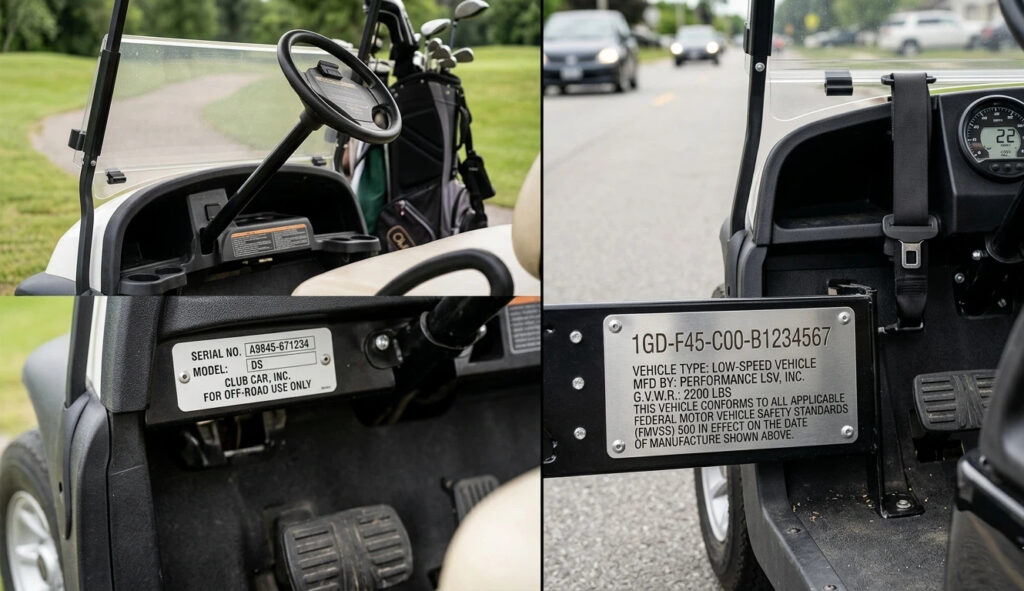
NEV vs Carrinho Golfe: Exploring the Performance Gap
Beyond the legalities, there is a massive engineering gap. Because a Neighborhood Electric Vehicle is built to handle 25 mph on roads shared with SUVs, the chassis is typically more robust.
In a NEV vs golf cart showdown, you will notice the NEV usually features better suspension, often automotive-style A-arms, and superior braking—frequently four-wheel hydraulic disc brakes. Standard golf carts often rely on simple mechanical drum brakes on the rear wheels only. If you are driving at 25 mph and a car pulls out in front of you, those four-wheel discs aren’t just a luxury; they are a necessity.
Furthermore, the Cr12MoV properties found in industrial tool steel ensure longevity in high-stress environments. Likewise, the materials used in NEV drivetrains are designed for constant road use rather than the intermittent stop-and-go of a golf course.
Navigating Local Street Legal Neighborhood Electric Vehicle Laws
While federal law (FMVSS 500) dictates how an NEV must be built, state and local laws dictate where it can be driven. Generally, most states allow a Neighborhood Electric Vehicle to operate on roads where the posted speed limit is 35 mph or less.
However, some local municipalities are stricter. For example, some beach towns in Florida have specific “LSV-only” zones, while others may ban them from certain high-traffic corridors even if the limit is 30 mph. Always check your local city ordinances. The “street legal” tag from a manufacturer means the vehicle can be registered, but it doesn’t grant you a “drive anywhere” pass.
Refer to the Insurance Institute for Highway Safety (IIHS) for a state-by-state breakdown of how these vehicles are regulated on local roads.
The Insurance Reality: Protecting Your Investment
Another area where the Neighborhood Electric Vehicle differs from the golf cart is insurance. Because an NEV is a registered motor vehicle, you cannot simply add it to your homeowner’s insurance as a “recreational toy” and expect full coverage for a road accident.
Most states require a Neighborhood Electric Vehicle to carry Personal Injury Protection (PIP) and Property Damage Liability (PDL). If you are involved in a collision with a standard car, having an automotive-grade insurance policy is the only thing protecting you from personal liability. Many insurance carriers have specific “Low-Speed Vehicle” policies designed specifically for this category.
Why Speed-Seekers Should Never “Settle” for a Cart
For the buyer who wants performance, the Neighborhood Electric Vehicle is the only logical choice. Trying to “overclock” a golf cart is a recipe for mechanical failure and legal headaches. A factory-built LSV/NEV offers a level of stability and power that a cart cannot match.
Whether it is the upgraded AC motor controllers or the high-capacity lithium battery packs, a Neighborhood Electric Vehicle is engineered to maintain 25 mph even with four passengers and a trunk full of groceries. It is the difference between a tool built for a specific job and a toy pushed beyond its limits.
Conclusion
Choosing between a golf cart and a Neighborhood Electric Vehicle comes down to one thing: your intended use. If you only plan to crawl across a fairway or your own private property, a golf cart is sufficient.
But if your lifestyle involves public roads, school drop-offs, or trips to the local market, the Neighborhood Electric Vehicle is the only choice that offers legal protection and automotive safety. Don’t be fooled by “street-ready” marketing. Look for the VIN, check the 25 mph limit, and ensure the vehicle meets the FMVSS 500 standard.
When you invest in a true Neighborhood Electric Vehicle, you aren’t just buying a ride—you’re buying the freedom to use the road legally and safely.
Still debating whether a standard golf cart or a street-legal LSV is right for your needs? Our technical team specializes in navigating the complexities of NEV regulations and can help you select a vehicle that is 100% compliant with federal safety standards.
Perguntas frequentes
Is a Neighborhood Electric Vehicle the same as an LSV?
Yes. In legal terms, they are the same. NEV is the common name used by consumers, while LSV (Low-Speed Vehicle) is the term used by the Department of Transportation.
Can I drive a golf cart on the road if I add blinkers?
Not necessarily. Unless the vehicle has a 17-digit VIN and a Manufacturer’s Certificate of Origin stating it meets FMVSS 500, adding lights does not make it a legal Neighborhood Electric Vehicle.
Do I need a driver’s license for an NEV?
Yes. Because it is a registered motor vehicle, you must have a valid driver’s license to operate it on any public road.
What is the maximum speed of a Neighborhood Electric Vehicle?
By federal law, the speed must be capped at 25 mph.
Can an NEV go on the highway?
No. They are strictly prohibited from highways or any road with a speed limit usually exceeding 35 or 45 mph (depending on the state).