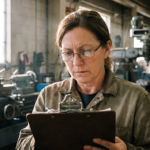
Modern manufacturing is no longer defined by assembly lines — it’s defined by algorithms, automation, and the strategic specialization of domestic production.
The factory floor has fundamentally transformed. Smart sensors, AI-driven quality control, and computer-controlled precision tools have replaced manual processes that once demanded enormous labor inputs. According to the 2026 Manufacturing Industry Outlook from Deloitte, manufacturers are accelerating investment in digital infrastructure to close efficiency gaps and outpace global competition.
Specialized niches are driving some of the fastest growth in the sector. Golf cart production, custom vehicle fabrication, and precision sheet metal fabrication represent categories where domestic manufacturers are carving out durable competitive advantages — not through volume, but through expertise. The data backs this up: a leading company achieved a 47 percent annual growth rate, illustrating just how rapidly focused manufacturing operations can scale when they serve a clearly defined market.
Domestic resilience has also moved from a talking point to a strategic priority. Supply chain disruptions of the early 2020s exposed the risks of offshore dependency, pushing US manufacturers to reinvest in local capacity and workforce development. Understanding the core terminology behind these industrial shifts — from fabrication methods to production models — is the essential first step toward navigating this landscape effectively.
Core Industrial Terminology You Must Know
Understanding the vocabulary of modern manufacturing is the foundation for evaluating every company, process, and innovation that follows in this guide.
The 2026 industrial landscape operates on a shared technical language. Without it, even the most detailed analysis loses context. Below are the four terms that anchor the rest of this article.
CNC Machining
A process where pre-programmed computer software directs the movement of cutting tools with sub-millimeter precision — the backbone of modern cnc machining services across aerospace, automotive, and defense sectors.
Sheet Metal Fabrication
The process of cutting, bending, and assembling flat steel or aluminum sheets into structural components — foundational to high-durability products like industrial chassis and enclosures, per industry standards.
Contract Manufacturing
A business model where a company outsources the production of parts or finished goods to a specialized third party, allowing brands to scale without owning physical production infrastructure.

Pillar Page
A central, comprehensive content hub that covers a broad topic in depth while linking out to supporting detail pages — exactly the structure this guide follows.
A common pattern is that the most competitive manufacturers combine all three physical processes — CNC machining, fabrication, and contract production — under one roof to reduce lead times. According to PwC’s industrial manufacturing analysis, operational integration is among the defining competitive advantages heading into 2030. With these terms established, the next step is seeing exactly which companies are putting them into practice at the highest level.
Top 10 Manufacturing Companies in the USA: The Giants of 2026
The largest industrial manufacturers in the USA don’t just build products — they set the trajectory for entire global supply chains. According to IndustrySelect, GE Aerospace and Lockheed Martin consistently lead the sector in both market cap and innovation output, making them the clearest benchmarks for what modern manufacturing excellence looks like in 2026.
Here are the ten companies defining American industrial leadership right now:
- GE Aerospace — Drives the future of flight through next-generation jet engine technology and advanced materials research.
- Lockheed Martin — Anchors U.S. defense capability with cutting-edge aircraft, missile systems, and space technology.
- RTX (Raytheon Technologies) — Operates under a “Built for Brilliance” philosophy, combining precision defense electronics with commercial aerospace components.
- Boeing — Remains a cornerstone of commercial and military aviation despite ongoing operational restructuring.
- Northrop Grumman — Specializes in autonomous systems, cybersecurity, and stealth aircraft platforms.
- Caterpillar — Leads in heavy construction and mining equipment, increasingly powered by computer-controlled precision tooling.
- Honeywell — Bridges industrial automation and aerospace with a broad technology portfolio.
- Raytheon Intelligence & Space — Delivers advanced sensor and communication systems for both defense and commercial markets.
- L3Harris Technologies — Focuses on mission-critical communications and electronic warfare.
- General Dynamics — Covers combat vehicles, submarines, and business aviation under one integrated structure.
The influence these giants carry extends well beyond their own facilities. Smaller contract manufacturers across the country calibrate their precision machining capabilities and quality standards directly to the supplier requirements set by these firms. According to the 2026 Manufacturing Industry Outlook from Deloitte, supply chain resilience and domestic sourcing are now primary strategic priorities — meaning the ripple effect from these top-tier companies is only growing stronger. That interconnected ecosystem of innovation and collaboration is exactly what the Manufacturing USA network was built to amplify.
Innovation and Collaboration: The Manufacturing USA Network
Public-private collaboration is now the single most powerful lever for compressing the timeline between industrial research and real-world production. According to ManufacturingUSA.com, the Manufacturing USA network focuses specifically on large-scale collaboration to bridge the gap between basic research and commercialization — a structural advantage that individual companies rarely replicate alone.
The network’s institutes pool resources across government agencies, universities, and private firms to fund R&D that no single organization could afford independently. This shared-cost model is especially impactful in capital-intensive sectors like electric vehicles and advanced battery systems, where prototype development can run into the tens of millions of dollars. The 2026 Manufacturing Industry Outlook from Deloitte reinforces that cross-sector partnerships are accelerating technology adoption across EV supply chains.
“Collaboration at scale is how we move innovations from the lab bench to the factory floor — no single company can carry that investment alone.” — Industry consortium leader, Manufacturing USA network
The downstream effect reaches even specialized segments. EV-adjacent products — including commercial utility vehicles and the modern 6-seater golf cart — benefit when a skilled contract manufacturer can access innovations developed through network-funded research, such as lightweight alloy fabrication and precision battery integration. Understanding how that collaborative R&D pipeline works sets the stage for examining exactly why brands increasingly trust specialized contract manufacturers with their most complex production challenges.
The Rise of Specialized Contract Manufacturing
Specialized contract manufacturers solve a problem brands can’t easily solve internally: deep technical expertise at scale, without the capital overhead of building it from scratch.
Understanding who manufactures a finished product often reveals a layered ecosystem of contract specialists operating well beneath consumer-facing brand names. As the 2026 Manufacturing Industry Outlook from Deloitte highlights, outsourcing complex fabrication allows brands to redirect investment toward design, distribution, and customer experience — while specialist partners handle the precision work.
Design
- Systems-level thinking drives product geometry, load ratings, and safety compliance before a single part is cut.
- For multi-passenger vehicles like the multi-seater golf cart, design must account for integrated sheet metal tolerances and structural load distribution across six occupants.
- CAD validation catches interference fits early, reducing costly downstream rework.
Fabricate
- Sheet metal fabrication — including laser cutting, stamping, and bending — demands tight dimensional control; deviations beyond ±0.5mm can compromise frame integrity.
- Computer-controlled machining workflows) automate repeatability across high-volume runs, eliminating operator variability.
- Material traceability logs support compliance audits at every production stage.
Assemble
- Final assembly quality gates include torque verification, weld inspection, and functional safety checks before any unit ships.
- Precision assembly protocols ensure that safety-critical fasteners meet rated specifications consistently.
- Statistical process control (SPC) data feeds back into upstream fabrication, closing the quality loop continuously.
The result is a manufacturing model where brand agility and engineering depth coexist — a dynamic that directly shapes how the industry recruits and organizes the people behind the production floor.
Workforce Evolution: Diversity and Scaling Operations
Manufacturing’s next competitive advantage isn’t just automation or supply chain agility — it’s the deliberate cultivation of diverse, high-capacity workforces that can scale operations from regional facilities to global markets.
Among the top 10 manufacturing companies in the USA and their international peers, workforce composition is increasingly treated as a strategic metric rather than a compliance checkbox. Leading manufacturers are demonstrating this shift in measurable terms: some facilities have already achieved over 70% female representation, proving that inclusive hiring pipelines directly correlate with operational stability and reduced turnover.
Bold callout: Workforce diversity isn’t a soft benefit — it’s a measurable driver of production consistency and retention across high-volume facilities.
Scaling from local to global markets demands more than adding headcount. It requires purpose-built infrastructure. New specialized facilities are expanding to 50,000 sqm to support the kind of global supply chain throughput that smaller campuses simply cannot accommodate. These industrial zones — purpose-designed for high-capacity output — combine precision automation controlled by computer) with human oversight at scale.
“The facilities being built today are designed around people and process simultaneously — square footage alone means nothing without the workforce architecture to fill it.”
The 2026 Manufacturing Industry Outlook from Deloitte reinforces that talent strategy and capital investment must move in parallel — a dynamic California’s industrial ecosystem illustrates with particular clarity, as the next section explores.
California’s Manufacturing Powerhouse and Job Market
California leads the nation in manufacturing jobs — particularly in aerospace, electronics, and precision fabrication — making it the single most important state for understanding where American industrial innovation is heading.
As noted in earlier sections, workforce diversity and specialized technical capability are reshaping competitive advantage. Nowhere is this more visible than California, where California leads the nation in manufacturing employment across tech-heavy sectors. The state’s unique advantage lies in its ability to fuse Silicon Valley’s software intelligence with the physical demands of heavy machinery — think computer-controlled precision equipment) operating alongside AI-driven quality systems.
Bold callout: California’s manufacturing sector isn’t a relic of the industrial past — it’s a preview of the 2026 factory floor.
The spirit of innovation and collaboration the Manufacturing USA network champions finds one of its strongest regional expressions here. California’s defense contractors, EV battery producers, semiconductor fabs, and aerospace integrators operate within dense supplier ecosystems that mirror exactly the kind of R&D-sharing networks national institutes encourage.
| Company | Sector | Key Location |
|---|---|---|
| Lockheed Martin | Aerospace & Defense | Palmdale |
| Northrop Grumman | Aerospace Systems | El Segundo |
| Tesla | EV Manufacturing | Fremont |
| Apple (contract ops) | Electronics Assembly | Cupertino |
| Raytheon Technologies | Defense Electronics | El Segundo |
| Intel (fabrication partners) | Semiconductors | Santa Clara |
| Parker Hannifin | Motion & Control | Irvine |
| BAE Systems | Defense Manufacturing | San Diego |
| Jabil | Electronics Contract Mfg. | San Jose |
| Edwards Lifesciences | Medical Devices | Irvine |
| Qualcomm | Chip Design & Production | San Diego |
| Aerojet Rocketdyne | Propulsion Systems | Sacramento |
| Flex Ltd. | Contract Electronics | Milpitas |
| General Atomics | Unmanned Systems | San Diego |
| L3Harris Technologies | Defense Tech | Los Angeles |
Hiring trends across these firms skew heavily toward roles that blend mechanical aptitude with digital fluency — process engineers who understand both torque specifications and machine-learning diagnostics. On the other hand, entry-level positions are increasingly difficult to fill due to skills mismatches, a challenge the broader industry patterns explored in this article consistently reinforce. The next section distills these patterns into clear, actionable takeaways.
Key Takeaways: What You Need to Know About the Industry
The modern manufacturing landscape rewards specialization, collaboration, and scale — and understanding these forces is essential for anyone navigating the 2026 industrial environment.
As covered throughout this guide, manufacturing’s center of gravity is shifting decisively toward high-precision, specialized niches. Broad-based commodity production increasingly moves offshore, while the USA doubles down on sectors where engineering complexity creates defensible advantages — aerospace, defense, medical devices, and specialized vehicles. Even niche segments like the multi-seater golf cart reflect this trend: multi-passenger utility vehicles now demand computer-controlled fabrication precision) that simply wasn’t standard a decade ago.

Bold takeaway: The top 5 manufacturing companies remain concentrated in aerospace and defense — a signal that capital-intensive, high-precision sectors define U.S. industrial leadership today.
Here’s what the evidence consistently points to:
- Specialization over volume — Manufacturers winning in 2026 focus on engineered complexity, not output scale alone.
- Network-driven R&D — Collaboration through programs like Manufacturing USA compresses innovation cycles that no single company could sustain independently.
- Workforce diversity as a health metric — Facilities with diverse teams and scalable labor pipelines consistently outperform peers, per 2026 industry outlook data.
- Facility scale signals stability — Larger, multi-site operations absorb supply chain shocks more effectively than single-location manufacturers.
These pillars apply whether you’re evaluating a potential contract partner, benchmarking your own operation, or simply building industry literacy. The questions most professionals still ask — about leading companies, product categories, and sourcing strategies — are exactly what the next section addresses directly.
Frequently Asked Questions About Manufacturing
Understanding the manufacturing landscape starts with answering the questions most people ask first — from identifying industry leaders to finding a reliable production partner.
What are the top 5 manufacturing companies? The global leaders by revenue and output consistently include Toyota, Samsung, Foxconn, Volkswagen, and General Electric — spanning automotive, electronics, and industrial equipment. Rankings shift annually based on output volume and innovation investment, as tracked by the Innovation Momentum Report.
What businesses are considered manufacturing? Manufacturing covers any business that transforms raw materials, components, or parts into a finished good. This spans food processing, textiles, automotive assembly, pharmaceuticals, electronics, and precision fabrication — a far broader category than most people assume.
What are the top 10 manufacturing products in the USA? The leading categories include:
- Petroleum and chemicals
- Motor vehicles and auto parts
- Aerospace components
- Semiconductors and electronics
- Food and beverages
- Medical devices
- Industrial machinery
- Steel and fabricated metals
- Plastics and rubber
- Defense equipment
How do I find a reliable contract manufacturer? Vet candidates by auditing quality certifications (ISO 9001 is standard), reviewing production capacity, and requesting references from similar industries. The 2026 Manufacturing Industry Outlook highlights supply chain transparency as a top screening criterion. For deeper technical resources and further reading on specific processes, the next section covers exactly where to look.
Related Resources and Further Reading
The manufacturing landscape rewards those who go deeper — and the resources below are your starting point for mastering the technologies and trends shaping 2026 and beyond.
Specialized industrial manufacturing continues to evolve at a pace that demands continuous learning. a leading manufacturer’s product line — including the a multi-seater vehicle — illustrates exactly how purpose-built engineering decisions translate into competitive differentiation. For readers ready to move from overview to application, these curated resources provide that next level of detail.
- a multi-seater vehicle Technical Specifications — Explore the full engineering breakdown of this multi-axis platform, including tooling capacity, spindle configurations, and workspace dimensions.
- The Evolution of CNC Machining in 2026 — Computer numerical control has transformed from single-axis automation into AI-assisted adaptive systems. This deep dive covers where the technology stands today and what operators need to know.
- Sheet Metal Fabrication for Electric Vehicles — As EV production scales globally, lightweight precision fabrication has become a critical bottleneck. This guide covers tolerances, materials, and process optimization for EV-specific applications.
- YouTube: Innovation and Collaboration in Manufacturing — A visual overview of how global manufacturers are building cross-industry partnerships to accelerate production and R&D cycles, aligned with findings from Verdantix’s 2026 industrial transformation predictions.
The manufacturers who thrive in 2026 will be those who treat knowledge as a production input — not an afterthought. Use these resources to close the gap between understanding the industry and operating at its leading edge.