Knowing how to select a manufacturer starts with a clear picture of exactly what you need built — before you contact a single vendor. According to Deloitte’s 2024 Manufacturing Industry Outlook, 83% of manufacturing executives believe digital technology is the primary driver of competitive advantage, which means your requirements document must account for both physical specs and digital production capabilities.
Here’s what to define upfront:
- Identify your machining needs. Determine whether your project requires computer-controlled precision cutting — such as CNC milling, turning, or custom metal fabrication —, and document every process involved.
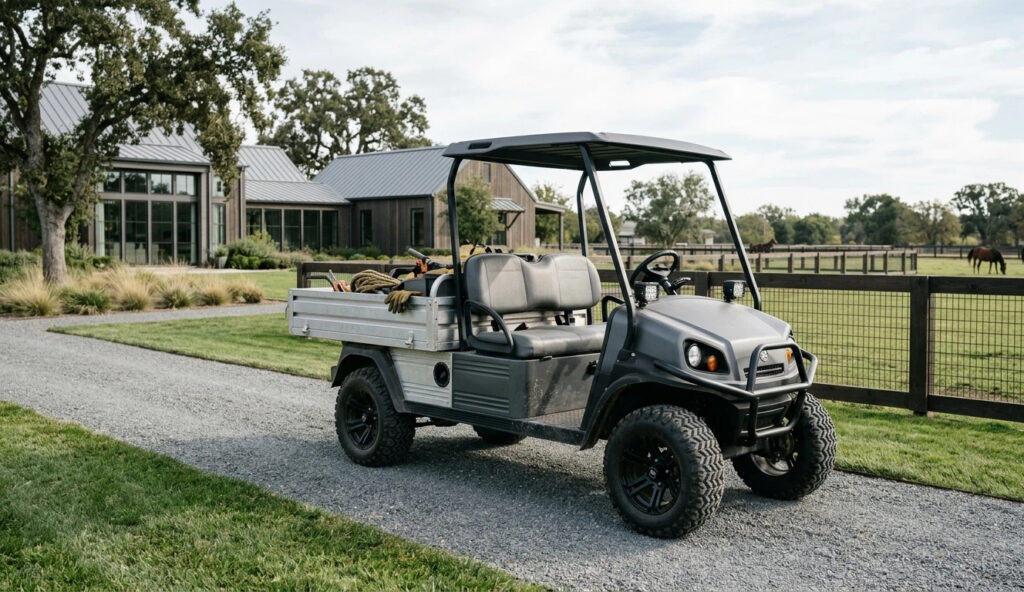
- Flag specialized assembly requirements. Projects like six-passenger electric vehicle or golf cart production involve unique structural and regulatory considerations that not every contract manufacturer can accommodate.
- Outline volume and production cadence. Specify minimum order quantities, ramp-up timelines, and whether you need ongoing contract manufacturing or a one-time production run.
- Define tolerance levels and material standards. Document acceptable dimensional tolerances (e.g., ±0.005″), required certifications (ISO, ASTM), and approved material grades for every critical component.
Technical specification clarity at this stage eliminates mismatched partnerships later. Once these requirements are locked in, you’re ready to evaluate whether prospective partners have the Industry 4.0 infrastructure to actually deliver them.
Step 1: Audit Potential Partners for Industry 4.0 Readiness
Once your technical requirements are locked in, the next filter is technology. Any credible industrial manufacturing company operating at scale today should be deeply invested in Industry 4.0 capabilities — the global smart manufacturing market is projected to grow at a CAGR of 14.9% through 2030, which means partners who lag now will fall further behind fast.
Use this audit sequence when evaluating each candidate:
- Request proof of digital twin usage. Ask whether they model production processes virtually before physical runs. Partners using digital twins catch design conflicts early and reduce costly rework.
- Assess automation and robotics integration. Tour their floor — or request video documentation. Facilities with integrated robotics and computer-controlled systems, including precision-driven machining processes, signal consistent output quality and scalability.
- Verify real-time supply chain visibility tools. Confirm they use live dashboards or connected platforms that surface inventory, lead times, and supplier disruptions immediately — not weekly reports.
- Look for predictive maintenance protocols. Ask how they handle equipment downtime. Partners leveraging IoT sensor data to anticipate failures — rather than react to them — protect your production schedules.
- Evaluate their data analytics capabilities. According to Industrial Equipment News, transparency around operational metrics is a reliable indicator of a partner’s long-term reliability and accountability.

A partner scoring well across these dimensions demonstrates operational maturity. However, technology alone isn’t the full picture — how a manufacturer handles environmental responsibility and regulatory compliance matters just as much, which brings us to the next critical step.
Step 2: Verify Sustainability and Regulatory Compliance
With your technology audit complete, the next critical filter is environmental and regulatory standing. As the World Economic Forum notes, “the shift toward sustainable manufacturing is no longer optional; it is a core business strategy that drives innovation.” When evaluating custom manufacturing services, a partner’s compliance record directly protects your brand reputation and supply chain continuity.
- Review green certifications — Confirm the manufacturer holds ISO 14001 (environmental management) and check their documented waste reduction and recycling programs.
- Confirm US regulatory compliance — Verify adherence to EPA standards, OSHA workplace requirements, and any industry-specific federal regulations relevant to your product category.
- Evaluate energy efficiency metrics — Request documented energy consumption data per unit produced. Partners investing in [computer-controlled precision processes](https://astromachineworks.com/what-is-cnc-machining/) often achieve measurable energy savings through optimized machine cycles.
- Assess material sourcing transparency — Ask for full supply chain disclosures, including conflict-mineral reporting and supplier audit records, per the [Global IMI checklist framework](https://www.global-imi.com/blog/checklist-choosing-right-manufacturing-partner).
A partner who handles these standards proactively — rather than reactively — signals operational maturity. However, certifications alone aren’t sufficient; request updated audit reports, not just certificates. Once sustainability is confirmed, the next logical question becomes capacity: can this partner actually scale to meet your production demands?
Step 3: Evaluate Scalability and Production Capacity
With technology and compliance verified, confirming a partner can grow alongside your demand is the next critical checkpoint. This contract manufacturing tutorial walks you through exactly how to pressure-test a facility’s production ceiling before signing any agreement.
- Analyze 24/7 production capability by requesting shift schedules, uptime reports, and maintenance logs. A partner who can sustain continuous cycles without significant downtime is essential for meeting tight delivery windows.
- Review large-scale project history by asking for case studies or references from previous high-volume industrial manufacturing engagements. Past performance is the most reliable predictor of future capacity.
- Check for specialized assembly lines, including configurations built for complex component families. Confirm whether their floor supports precision setups — for example, lines using computerized machining control — before assuming compatibility with your spec.
- Inquire about the labor-to-automation ratio. According to the National Association of Manufacturers, advanced automation and robotics drive significant increases in production speed while reducing long-term operational costs — a ratio weighted toward automation signals resilience under volume spikes.
Scalability is not just about headcount. Use the table below to quickly compare manual versus automated capacity profiles when evaluating candidates:
| Factor | Manual-Heavy Facility | Automation-Heavy Facility |
|---|---|---|
| Volume flexibility | Limited | High |
| Consistency at scale | Variable | Consistent |
| Lead time under surge | Increases sharply | Remains stable |
| Long-term cost trend | Rising labor costs | Declining per-unit cost |
Once capacity checks out on paper, the next logical move is seeing operations firsthand — which leads directly into scheduling your facility tour.
Step 4: Conduct a Virtual or On-Site Facility Tour
Before you set up a manufacturing partnership on paper, you need to verify claims with your own eyes. A facility tour — whether virtual or in person — transforms vague assurances into concrete evidence. Here’s how to make the most of it.
- Schedule the tour in advance and request access to live production areas, not just a showroom walkthrough. Staged environments rarely reveal real operational conditions.
- Inspect the machining floor and assembly stations. Look for organized workstations, modern equipment, and clear process flow. A well-maintained computer-controlled machining environment signals disciplined operations.
- Observe quality control checkpoints in action. Watch how parts move through inspection phases and whether testing documentation is readily available on the floor.
- Meet the engineering team directly. According to industry guidance on selecting manufacturing partners, collaboration potential is best assessed through candid conversation — not slide decks. Innovation and collaboration, as the Manufacturing USA network emphasizes, are the true pillars of competitive manufacturing.
- Verify safety and automation tools are physically implemented, not just listed in a brochure. Look for functional robotics, safety signage, and automated monitoring systems.
- Ask the floor manager targeted questions. Three to press on:”How do you handle a mid-run quality deviation?””What’s your current equipment utilization rate?””How does your team communicate design changes with the client?”
A thorough tour builds the trust needed before moving into contract negotiations — which is exactly where the next step takes you.
Step 5: Finalize the Contract and Onboarding Process
With facility verification complete, converting your due diligence into a structured agreement is where partnerships either solidify or unravel. A well-executed onboarding process eliminates ambiguity and keeps both sides aligned from day one.
- Define success metrics for the first production run before signing anything. Specify acceptable defect rates, cycle times, and yield targets in writing so performance expectations are unambiguous.
- Establish communication protocols upfront — agree on a project management platform, meeting cadence, and escalation paths. Clear channels prevent costly delays when issues arise mid-production.
- Set up a secure data-sharing environment for [CAD and design files](https://www.goodwin.edu/enews/what-is-cnc/), tolerances, and bill-of-materials documents. Confirm file format compatibility and access permissions before transferring any proprietary assets.
- Confirm the prototype schedule in the contract, including milestone dates, revision windows, and sign-off procedures. A fixed timeline holds both parties accountable.
- Agree on a change-order process so scope adjustments don’t stall production. Document how design changes are submitted, reviewed, and priced.
- Review liability and IP clauses with legal counsel. According to [NIST’s supplier selection guidance](https://www.nist.gov/blogs/manufacturing-innovation-blog/8-ways-improve-your-supplier-selection-process), formalizing roles and responsibilities is foundational to any durable supplier relationship.
A signed contract with embedded KPIs transforms a promising evaluation into an accountable partnership. With these operational foundations in place, stepping back to consolidate your selection criteria into a repeatable framework becomes the logical next move.
How to Master the Key Takeaways for Partner Selection
With your contract finalized and onboarding underway, consolidating the most critical decision criteria keeps your selection process sharp — and defensible to stakeholders. These four takeaways distill everything covered so far into actionable reference points.
- Prioritize digital readiness and automation first. Top manufacturing companies in California and across the USA are increasingly defined by technological innovation, according to industry selection frameworks. A partner’s investment in automated controls — including computer-driven machining systems — directly determines long-term cost efficiency and defect reduction.
- Treat sustainability as a strategic advantage. In practice, partners with documented environmental programs win more contracts and face fewer supply chain disruptions. Sustainability is a differentiator, not a compliance checkbox.
- Demand proven scalability through specialized assembly experience. A manufacturer like Varyon Machinery, with deep expertise in complex vehicle, industrial builds, and signals the kind of scalability that supports growth without sacrificing precision.
- Make direct facility audits non-negotiable. For high-stakes industrial contracts, remote reviews are insufficient. An on-site audit confirms that certifications, equipment, and workforce capabilities match what’s on paper.
These takeaways set a clear baseline for any partnership evaluation. If specific questions remain — about CNC verification, contract structures, or automation costs — the next section addresses the most common selection challenges directly.
How to Resolve Common Manufacturing Selection Questions
Closing out your partner search means clearing up the questions that surface most often at the decision stage. Work through each answer below to sharpen your final choice.
What are the top 5 manufacturing companies for specialized vehicles? Leading names for specialized vehicle production include General Dynamics, BAE Systems, Oshkosh Defense, Navistar Defense, and AM General. Industry analysts at Zeiss also note that GE Aerospace and Lockheed Martin rank among the top manufacturing giants recognized for technological advancement — a benchmark worth measuring prospective partners against. How do I verify a manufacturer’s CNC precision? Request documented tolerance reports and ask for sample parts machined to your specifications. Understanding how automated control systems work) helps you ask sharper questions about spindle speed, axis accuracy, and surface finish standards during facility audits.
What is the difference between contract and custom manufacturing? Contract manufacturing produces parts to your exact design using the partner’s equipment and labor. Custom manufacturing involves the partner co-developing the design — offering more flexibility but typically higher upfront engineering costs.
How does automation impact the final product cost? Automation reduces per-unit labor costs and minimizes human error, which lowers rework expenses. However, higher capital investment in automated lines can raise minimum order thresholds, so confirm volume requirements upfront.
Apply these answers as a final filter, then move forward with the industrial manufacturing partner that checks every box your operation demands.