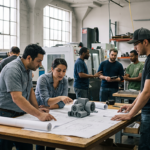
American manufacturing is undergoing its most significant transformation in decades — and the companies who understand what’s driving it will define the next era of industrial leadership.
The “Made in USA” label has never carried more strategic weight. Reshoring initiatives, supply chain disruptions from recent global events, and rising consumer demand for transparency have pushed domestic production back to the forefront. Today, businesses asking who manufactures their components locally aren’t just making a patriotic choice — they’re making a competitive one, trading overseas lead times for speed, reliability, and quality control.
The scale of what’s coming is staggering. Smart factories in the automotive sector alone are estimated to create significant value by 2025, signaling a broader industrial shift that touches every vertical from aerospace to consumer goods. Automation, AI-driven quality control, and connected production lines are no longer futuristic concepts — they’re active investments happening on factory floors right now.
Delivery speed has emerged as the primary competitive differentiator, eclipsing price as the top factor in supplier selection. Meanwhile, geographic innovation hubs — from the Midwest’s advanced manufacturing corridor to Texas’s expanding industrial base — are concentrating talent, capital, and technology in ways that are reshaping the national production map.
To navigate this landscape effectively, it helps to start with the language shaping it. The next section breaks down the essential terminology every manufacturing professional needs to know.
Essential Manufacturing Terminology
Smart manufacturing vocabulary is the foundation every industry observer needs — especially when evaluating the top 10 manufacturing companies in the USA and the technologies reshaping their operations.
Smart Factory
A highly digitized production facility that uses IIoT, AI, and real-time data to automate decisions and optimize output with minimal human intervention.
IIoT (Industrial Internet of Things)
A network of interconnected sensors, instruments, and devices embedded across production equipment to collect and transmit operational data continuously.
Predictive Maintenance
A data-driven strategy that analyzes equipment performance signals to anticipate failure before it occurs — reducing unplanned downtime and repair costs. In practice, [IoT-connected diagnostics](https://varyonmachinery.com/the-evolution-of-resort-mobility-why-electric-shuttles-are-the-new-standard/) apply this same logic across industries far beyond the factory floor.
Speed-to-Market
The total elapsed time from the start of production to the moment a finished product reaches the customer — a critical competitive metric in modern manufacturing.

According to the Policymaker’s Guide to Smart Manufacturing, these concepts work as an integrated system rather than isolated upgrades. As of 2023, roughly one-quarter of automotive plants had already transitioned into smart factories — a clear indication that these terms reflect real operational shifts, not theoretical ideals. Understanding these terms sets the stage for assessing the giants who are putting them into practice.
Top 10 Manufacturing Giants in the USA
The largest manufacturing companies in the USA combine decades of engineering heritage with relentless R&D investment — and understanding who leads the field is essential for anyone tracking manufacturing USA trends.
Across defense, aerospace, and advanced propulsion, a handful of corporations consistently define what American industrial leadership looks like. Lockheed Martin and GE Aerospace remain top-ranked U.S. manufacturers by both revenue and technological patents, setting benchmarks that ripple across the entire supply chain.
Here are the top players shaping U.S. manufacturing today:
- GE Aerospace — Develops next-generation jet engines and propulsion systems powering commercial and military aircraft worldwide.
- Lockheed Martin — The nation’s largest defense contractor, producing advanced aircraft, missile systems, and space technology.
- RTX (Raytheon Technologies) — Delivers cutting-edge radar, missile defense, and avionics systems across global defense programs.
- Pratt & Whitney — A century-old engine manufacturer supplying high-thrust turbofan engines for both commercial and military fleets.
- Boeing — Designs and builds commercial jetliners, military aircraft, and space launch systems.
- General Dynamics — Specializes in combat vehicles, submarines, and business aviation platforms.
- Northrop Grumman — Leads in stealth aircraft, autonomous systems, and space infrastructure.
- Caterpillar — The global benchmark for construction and mining equipment manufacturing.
- Deere & Company — Produces precision agriculture and heavy construction machinery at massive scale.
- 3M — Manufactures thousands of industrial, safety, and consumer products across diversified sectors.
What unites these companies is not just scale — it’s their sustained commitment to innovation that keeps U.S. manufacturing competitive globally. That commitment increasingly depends on coordinated research networks and public-private collaboration, which is exactly where the next layer of the American manufacturing story begins.
Innovation and Collaboration: The Manufacturing USA Network
Public-private collaboration is the single most effective mechanism accelerating the transition to smart factories across the United States. Manufacturing USA operates as a network of linked institutes jointly sponsored by the Departments of Commerce, Defense, and Energy — each institute targeting a specific technology gap between laboratory research and full-scale production. By sharing infrastructure costs and intellectual risk among universities, federal agencies, and private manufacturers, the network dramatically lowers the barrier for smaller suppliers to adopt advanced robotics, additive manufacturing, and digital process controls.
Shared investment reduces adoption risk — a critical advantage when integrating expensive, unproven technologies. Regional manufacturing clusters amplify this effect by concentrating talent, suppliers, and testing facilities in the same geography, creating measurable job growth and skills pipelines that anchor communities to long-term industrial activity. A common pattern in these clusters is that early adopters share performance data openly, accelerating learning curves for neighboring facilities.
Collaboration Spotlight: The Clean Energy Smart Manufacturing Innovation Institute, operating within the Manufacturing USA network, has connected hundreds of small and mid-sized manufacturers with energy-efficiency technologies that cut operating costs while reducing carbon output — demonstrating that sustainability and competitiveness reinforce each other.
Sustainable and smart manufacturing processes are increasingly inseparable goals. As the network matures toward its 2030 and 2035 vision, the emphasis is shifting from individual pilot projects toward system-wide digital integration — setting the stage for the AI-driven factory environments explored in the next section.
The Rise of Smart Factories: AI and Machine Learning
Smart factory technology is no longer a future aspiration — it’s the defining competitive advantage separating industry leaders from those falling behind today.
Building on the innovation and collaboration the Manufacturing USA network fosters, individual facilities are now deploying AI and machine learning at remarkable scale. According to Rockwell Automation, 88% of manufacturers have already invested or plan to invest in AI and ML within 12 months — a figure that signals a genuine industry-wide inflection point, not a gradual trend.
Computer vision is transforming quality control on the production floor. Real-time imaging systems detect microscopic defects in components far faster and more consistently than manual inspection, reducing waste and warranty costs simultaneously. On assembly lines for complex machinery, collaborative robots — or “cobots” — now handle repetitive or hazardous tasks with precision that human workers cannot match at scale.
Perhaps the most commercially compelling application is predictive analytics for equipment maintenance. By continuously analyzing sensor data — vibration, temperature, pressure — AI models flag potential failures hours or days before they occur. Unplanned downtime costs manufacturers an estimated $50 billion annually across the U.S., making this capability a direct bottom-line driver rather than a technical novelty.
The 2025 Smart Manufacturing Survey from Deloitte reinforces that facilities integrating these tools report measurable gains in throughput, safety, and energy efficiency. The geography of where these gains are concentrated, however, tells its own story — and nowhere illustrates that better than the western United States.
California and the West: A Hub for High-Tech Manufacturing
California’s manufacturing sector is a global force — ranking among the top 15 economies worldwide and anchoring the western United States as the nation’s premier hub for high-technology production.
Where Silicon Valley’s software culture meets physical production, something remarkable happens. Engineers who design next-generation chips and autonomous systems work within miles of the factories that build them, creating feedback loops between R&D and the shop floor that are nearly impossible to replicate elsewhere. This geographic density accelerates iteration, compresses development cycles, and produces manufacturing ecosystems with unusually high output per worker.
The key sectors driving California’s dominance include:
- Aerospace and defense — Home to major production corridors in Southern California, the state supplies critical components to the global aviation industry
- Medical devices — The Bay Area and San Diego host dense clusters of device manufacturers benefiting from proximity to world-class research universities
- Specialized machinery — Custom and motorized equipment manufacturers serve agriculture, logistics, and resort mobility markets statewide
California consistently attracts some of the top 5 manufacturing companies in advanced technology sectors, according to employment data from Indeed and BuiltIn, which identifies the state as the national leader in high-tech manufacturing employment. Specialized manufacturers across the San Francisco Bay Area, in particular, benefit from access to precision engineering talent, robust supplier networks, and capital that few regions can match.
That density of talent and infrastructure is reshaping how quickly manufacturers can bring products to market — a competitive reality the next section examines directly.
Speed as a Competitive Advantage: The Speed Advantage Rule
In modern U.S. manufacturing, delivery speed has become as decisive a competitive factor as product quality itself. Traditional lead times — often stretching 12 to 20 weeks — are increasingly misaligned with buyers who operate leaner inventories and shorter project cycles. When procurement timelines slip, entire operations stall, and loyalty erodes fast.
The benchmark separating market leaders from the rest is stark. As Ohio Fabricators Leadership put it directly: “The most important thing for people to understand is we are a company that manufactures the highest quality products, and delivers 50 percent faster than our nearest competitor.” That gap isn’t a marginal edge — it’s a structural advantage that compounds across every sales cycle and customer relationship.
“Delivering 50% faster isn’t just a logistics win — it’s a trust signal that reshapes how buyers perceive your entire brand.”
Localized manufacturing is central to closing that speed gap. When production, warehousing, and distribution are geographically concentrated, supply chain friction drops significantly — fewer handoffs, shorter transit windows, and faster response to custom orders. This approach reduces dependence on overseas suppliers and insulates operations from global disruption.
Varyon Machinery applies these principles directly to motorized equipment, prioritizing domestic production workflows designed to compress fulfillment timelines without compromising build standards. For buyers sourcing specialized equipment — where delays translate to real operational costs — that commitment to speed redefines the value proposition entirely.
As the manufacturing landscape continues shifting, delivery performance is becoming a baseline expectation rather than a differentiator — a trend that sets the stage for the emerging standards shaping the industry’s next chapter.
Future Outlook: Manufacturing Trends for 2026
The next 24 months will separate manufacturers who adapt from those who stall — and the dividing lines are content strategy, connected technology, and environmental accountability.
Content and communication are undergoing a structural shift. According to the Content Marketing Institute, 62% of manufacturing marketers are moving budgets toward video, while 50% are prioritizing thought leadership heading into 2025. B2B procurement decisions increasingly depend on expertise-driven content — not brochures. Buyers expect manufacturers to demonstrate capability through technical explainers, case studies, and executive insight before a conversation ever starts.
IIoT normalization is the next major operational shift. What was once exclusive to large-scale plants is now reaching small-to-medium enterprises (SMEs). Affordable sensor networks, cloud-based analytics, and modular platforms are making smart factory infrastructure accessible at every tier of the supply chain — not just Tier 1 suppliers.
Sustainability has moved from a marketing checkbox to a hard procurement requirement. Customers, regulators, and investors now demand measurable environmental performance. Manufacturers without credible emissions reduction plans face real sourcing exclusions.
Key trends shaping the next 24 months:
- Expert video content replacing static sales collateral in B2B outreach
- Thought leadership becoming a primary trust signal in procurement cycles
- IIoT adoption expanding rapidly among SMEs through lower-cost entry points
- Carbon accountability embedded into supplier qualification criteria
The patterns outlined here — speed, AI adoption, smart infrastructure, and sustainability — converge into a broader strategic picture worth synthesizing, which the key takeaways ahead will map out directly.
Key Takeaways: Navigating the U.S. Manufacturing Sector
U.S. manufacturing is undergoing its most significant structural shift in a generation — and the window to adapt is narrowing fast.

The themes covered throughout this guide converge on a clear set of strategic imperatives. Here are the core principles every manufacturer, supplier, and industry stakeholder should carry forward:
- Smart factories are the value engine. The transition to connected, data-driven production is already reshaping the competitive landscape. With 25% of U.S. plants already converted, early movers hold a compounding advantage as the broader $37T value shift accelerates.
- Speed is the new quality benchmark. Delivering 50% faster than legacy lead times is no longer a premium differentiator — it is the baseline expectation in competitive markets. Manufacturers who cannot meet this standard risk losing contracts regardless of product quality.
- AI and ML adoption is effectively mandatory. With 88% adoption rates across the sector, artificial intelligence and machine learning have moved from pilot programs to core operational infrastructure. Holding back now means falling further behind each quarter.
- Collaboration multiplies innovation. Networks like Manufacturing USA demonstrate that shared R&D infrastructure and cross-sector partnerships consistently outperform isolated investment.
The manufacturers who treat these four pillars as integrated strategy — not separate initiatives — are the ones building durable competitive positions. If foundational questions remain about where to start, who leads the sector, or how to find the right partners, the next section addresses the most common decision points directly.
Frequently Asked Questions About U.S. Manufacturing
U.S. manufacturing spans every industry that transforms raw materials into finished goods — and understanding its leaders, products, and sourcing strategies is essential for anyone operating in this space.
What are the top 5 manufacturing companies by revenue vs. innovation? By revenue, the consistent leaders are companies in aerospace, automotive, and industrial equipment — think large-scale defense contractors and automakers generating hundreds of billions annually. By innovation, rankings shift toward firms investing heavily in automation, AI-driven production, and R&D; NIST’s manufacturing innovation data confirms that R&D investment, not just output volume, increasingly defines competitive positioning.
What businesses are considered manufacturing?Manufacturing includes any business that transforms raw materials into new products using labor, machines, and tools — from food processing and textile production to semiconductor fabrication and aerospace assembly. If a business physically changes inputs to create a sellable output, it qualifies as manufacturing.
How can I find a reliable U.S. manufacturer for specialized equipment? Start with industry trade associations, domestic supplier databases, and verified distributor networks. Prioritize manufacturers with documented quality certifications (ISO, AS9100), auditable production facilities, and verifiable delivery track records.
What are the top manufacturing products in the USA today? Leading categories include aerospace components, pharmaceuticals, semiconductors, industrial machinery, motor vehicles, and consumer electronics — sectors where U.S. manufacturers maintain strong global competitiveness through technology investment and skilled labor. The shift toward smart factory infrastructure, as tracked by the Deloitte’s 2025 smart manufacturing survey, signals these categories will deepen their dominance through 2030. Manufacturers aligning their product strategy with these high-growth verticals are best positioned for the decade ahead.