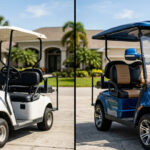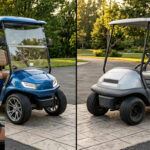
If you live in a golf cart community like The Villages in Florida or a coastal town in California, you’ve likely seen them: sleek, quiet vehicles cruising alongside regular traffic, sporting full-size license plates. These aren’t just glorified lawnmowers; they are Low-Speed Vehicles (LSVs).
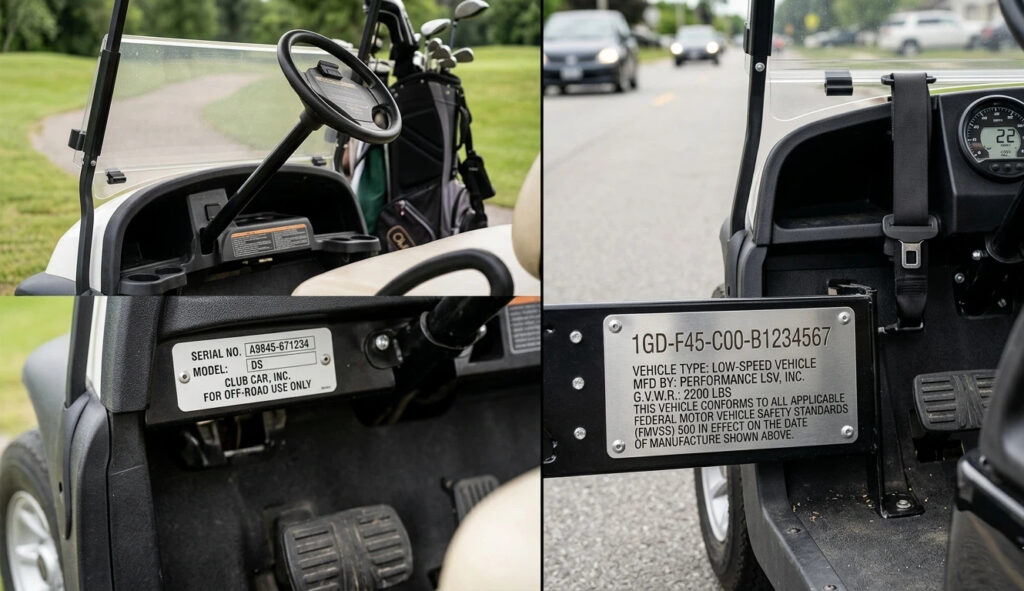
The journey to turning a standard cart into a Street Legal Golf Cart is paved with specific hardware requirements and federal safety standards. You can’t simply drive off the green and onto the asphalt without facing heavy fines or having your vehicle impounded. The “Golden Ticket” to this transition is the 17-digit VIN, which transforms your property-only vehicle into a registered mode of transportation.
Tabla de contenidos
LSV vs. Golf Cart: Why the 17-Digit VIN Matters
Before picking up a wrench, you must understand the difference between a golf cart and an LSV. A traditional golf cart is designed for the course, usually capped at 15 mph, and exempt from most federal safety regulations. An LSV, however, is a federally defined motor vehicle category. Achieving the status of a Street Legal Golf Cart requires meeting stringent criteria that go far beyond aesthetics.
To qualify for a 17-digit VIN, your vehicle must meet the FMVSS 500 Safety Standards. This federal mandate ensures that any vehicle capable of speeds between 20 and 25 mph has the structural integrity and safety equipment to share the road with 4,000-pound SUVs. Without that hard-stamped VIN, your local DMV will never issue a title or a plate, no matter how many mirrors you install.
The Hardware Checklist: Essential Electric Golf Cart Upgrades
Converting a cart requires more than a “universal” light kit from a random online marketplace. To pass a state inspection and successfully build a Street Legal Golf Cart, your hardware must be automotive-grade.
1.The Windshield: Acrylic is Not Enough
One of the most frequent reasons for inspection failure is the windshield. While a fold-down acrylic windshield is fine for the course, a Street Legal Golf Cart requires an AS4 or AS5 certified automotive safety glass windshield.
When sourcing your DOT approved windshield for golf cart street legal kit, look for the etched DOT stamp in the corner. If it doesn’t have that stamp, the inspector will reject it immediately. This glass is designed not to shatter into jagged shards upon impact, protecting you and your passengers in a collision.
2.Lighting and Signaling Systems
Your lighting must function exactly like a car’s. To maintain the safety profile of a Street Legal Golf Cart, this includes:
- High and Low Beam Headlights: For visibility in varying conditions.
- Turn Signals: Both front and rear, integrated with a steering column stalk.
- Brake Lights: Activated by the brake pedal, not just a manual switch.
- Reflectors: On all four corners of the vehicle.
Navigating FMVSS 500: Federal Safety Requirements
Beyond lights and glass, to be considered a Street Legal Golf Cart, you must install:
- Three-Point Seat Belts: Lap belts are often insufficient; most states require shoulder harnesses for all occupants.
- Mirrors: An interior rearview mirror and at least one driver-side exterior mirror.
- Parking Brake: A dedicated mechanical parking brake that can hold the vehicle on a 20% grade.
- Pedestrian Alert System: Since electric carts are nearly silent, newer regulations often require an acoustic alert for low-speed maneuvering.
Hardware Comparison: Standard vs. Street Legal Requirements
| Feature | Standard Golf Cart | Street Legal Golf Cart |
| Top Speed | 12 – 15 MPH | 20 – 25 MPH |
| Parabrisas | Acrylic / Plastic Fold-down | AS5 Certified Safety Glass (DOT) |
| Seat Belts | Optional / Not required | 3-Point DOT Approved Harnesses |
| Brakes | Rear-wheel mechanical | 4-wheel braking (usually required) |
| VIN | Serial Number only | 17-Digit ISO 3779 Compliant VIN |
| Road Access | Private property / Cart paths | Public roads (usually 35 MPH or less) |
How to Get a 17-Digit VIN: The Registration Process
Once your hardware is installed, the paperwork begins. This is where many owners get frustrated with 17-Digit VIN Registration. In most states, you must apply for a “Specially Constructed Vehicle” or “Assembled Vehicle” title.
The cost of 17-digit VIN application for custom builds varies, but generally includes a state inspection fee ($50–$200), title fees, and the cost of the plate itself. Once the inspector verifies that your Street Legal Golf Cart meets all FMVSS 500 Safety Standards, they will rivet a metal VIN plate to the frame, and you can officially head to the DMV. You will need to provide original receipts for all major components to prove the vehicle wasn’t built from stolen parts.
Regional Nuances: Florida and California Rules
If you are wondering how to make a golf cart street legal in Florida/California?, the answer depends heavily on “Home Rule.” While federal law sets the equipment standards, state and local municipalities decide which roads you can drive on.
Summary of the Street Legal Requirements Checklist
To ensure you don’t miss a step in your conversion, follow this Street Legal Golf Cart requirements checklist:
1.Speed Calibration: Ensure your motor/controller is programmed for 20-25 mph.
2.AS5 Glass: Swap the plastic windshield for DOT-approved glass.
3.Full Lighting: Install headlights, tail lights, and turn signals.
4.Mirror Suite: Mount interior and driver-side mirrors.
5.Reflective Tape: Apply red/amber reflectors to the sides and rear.
6.3-Point Belts: Bolt shoulder harnesses directly to the frame or a roll-over bar.
7.VIN Application: Schedule your state-certified inspection.
Conclusión
Building a Street Legal Golf Cart is a rewarding project that adds massive utility to your vehicle. However, the hardware is non-negotiable. Whether you are navigating the LSV (Low-Speed Vehicle) Conversion for a beach house or for daily errands, prioritizing DOT-approved components is the only way to protect your investment and your safety.
Don’t settle for “street-look” kits. Your safety—and your 17-digit VIN—depends on choosing a genuine Street Legal Golf Cart configuration.
Preguntas frecuentes
Can I just use a 17-digit VIN from a scrapped car?
Absolutely not. That is considered VIN switching and is a federal felony. Your VIN must be uniquely assigned to your specific vehicle by the state or a licensed manufacturer.
Is insurance required for a street legal cart?
Yes. Since it is registered as a motor vehicle, you must carry at least the state-minimum liability insurance.
How do I know if my windshield is DOT approved?
Look for the “AS4” or “AS5” code and a “DOT” circle etched into the corner of the glass. If it is plain plastic, it won’t pass.
Can a gas golf cart be made street legal?
Yes, provided it meets the same FMVSS 500 Safety Standards and emissions requirements for its class.
What is the most expensive part of the conversion?
Usually the safety glass windshield and the labor for the 17-digit VIN registration and inspection process.