When outfitting your property, warehouse, or recreational land, choosing between a Golf cart vs UTV is a common and expensive dilemma. Both vehicles are designed to move people and gear efficiently, but they are engineered for entirely different physical extremes.
To settle the Golf cart vs UTV debate, you must look past the initial sticker price. You need to evaluate how the machine’s physical limits, safety ratings, and ongoing maintenance schedules align with your daily tasks.
Here is the professional breakdown of capabilities to help you decide.
Table of Contents
The Physics of Dirt: Suspension and Terrain
Let’s start with the chassis architecture. If your land features deep ruts, rocks, or steep inclines, Off-road Capability dictates your choice.
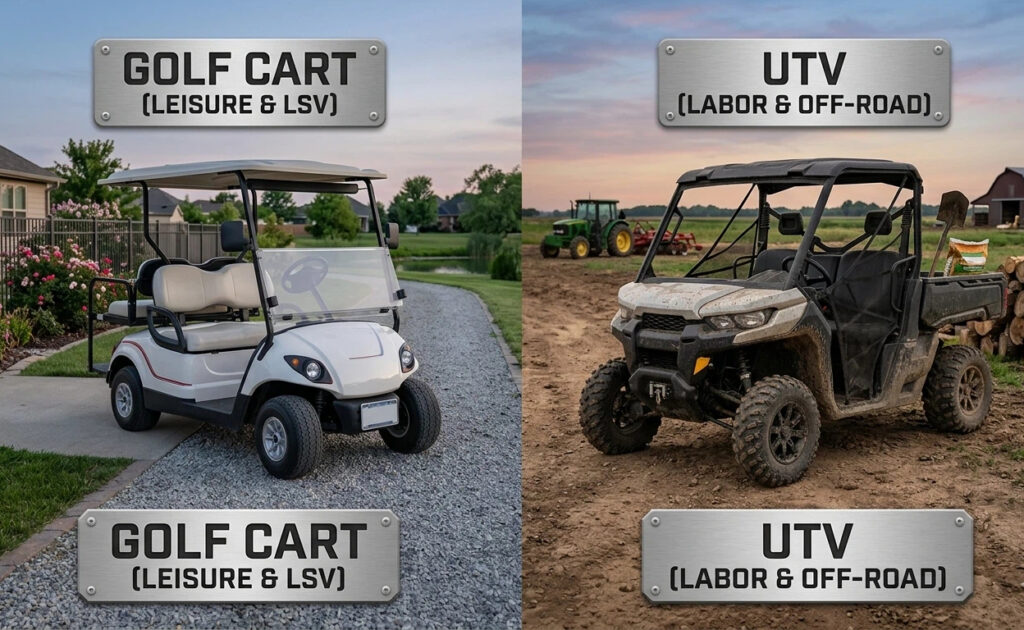
A standard cart is designed for manicured grass and pavement. Even with an aftermarket lift kit, the frame and suspension geometry remain limited. Evaluating a Golf cart vs UTV in deep mud or rocky terrain always favors the latter. UTVs (Utility Task Vehicles) are built from the ground up for the trail. They feature independent dual A-arm setups with extensive Suspension Travel (often exceeding 10 inches), allowing the tires to maintain contact and traction over severe obstacles.
The Workhorse Metrics: Hauling and Towing
When examining a Golf cart vs UTV for farm work and property maintenance, the numbers speak for themselves. You must strictly compare the Payload and Towing Capacity.
A heavy-duty cart with a rear cargo box might handle 400 to 500 lbs. That is adequate for bags of mulch or yard tools. However, a work-focused side-by-side acts as a mini-tractor. It can easily tow up to 2,000 lbs and carry a half-ton of gravel in a hydraulic dump bed. For heavy hauling, the Golf cart vs UTV comparison isn’t even close—the utility vehicle is mandatory.
Speed, Safety, and Structural Integrity
For large acreages, Top Speed and Acceleration matter. Utility vehicles comfortably cruise at 40 to over 60 mph, powered by large-displacement engines or high-voltage electric motors. Carts typically max out around 15 to 25 mph.
But with speed comes significant risk. Because of their high-speed, off-road nature, every modern side-by-side includes a factory-certified Roll Over Protective Structure (ROPS). Standard carts feature simple sunshades that offer zero crash protection. Safety is a critical differentiating factor in the Golf cart vs UTV analysis.
Authority Reference: The Occupational Safety and Health Administration (OSHA) strictly mandates ROPS and seatbelts for off-road agricultural vehicles to prevent crush injuries. Source: OSHA Agricultural Safety Standards.
The Great Outdoors: Stealth vs. Force
Many outdoorsmen inevitably ask: Are golf carts or UTVs better for hunting and woods? The answer depends entirely on your stealth requirements.
An electric buggy offers a nearly silent approach, minimizing scent and noise pollution when accessing tree stands. However, if you need to drag a heavy buck out of a flooded ravine, the 4×4 locking differentials of a utility vehicle are indispensable. Weighing a Golf cart vs UTV in the woods is a direct trade-off between absolute stealth and brute traction.
Neighborhoods and Power Types
What if your primary goal is simply cruising the neighborhood or navigating an HOA community? Here, the Electric golf cart vs gas UTV for quiet residential use debate strongly favors the cart.
Gas side-by-sides are loud and frequently barred from residential communities due to noise ordinances. Furthermore, modern carts benefit massively from Lithium-ion Battery Conversion technology. Dropping 300 lbs of outdated lead-acid batteries for a zero-maintenance lithium pack transforms the vehicle’s range and lifespan. For pavement cruising, choosing a Golf cart vs UTV is an easy win for the cart.
The Financial Reality: Total Cost of Ownership
Budgeting is not just about the MSRP on the showroom floor. Smart buyers are actively Comparing golf cart and UTV maintenance costs over 5 years.
Utility vehicles are complex machines. They require engine oil changes, CVT belt replacements, differential fluid swaps, and expensive off-road tire replacements. Carts, especially modern lithium-powered models, need little more than tire pressure checks, occasional brake adjustments, and a wall plug. When tracking the total cost of ownership, the Golf cart vs UTV math heavily favors the mechanical simplicity of the cart.
The Legal Landscape: Pavement Rights
Before you swipe your company or personal credit card, check your local municipal statutes. Navigating Street legal golf cart vs UTV regulations in Florida/Texas (and many other coastal or southern states) is highly complex.
Carts can frequently be registered as Low-Speed Vehicles (LSVs). With the addition of a windshield, wipers, seatbelts, and DOT tires, they are legally permitted on public roads with speed limits up to 35 mph. Conversely, utility vehicles are frequently banned from public asphalt entirely due to their off-road emissions, lacking safety glass, and aggressive tire treads.
Authority Reference: The National Highway Traffic Safety Administration (NHTSA) defines the strict federal parameters of what constitutes a legal LSV versus an off-road vehicle. Source: NHTSA Standard No. 500.
Legal compliance is a hard boundary in the Golf cart vs UTV decision tree. If you need to drive to the local grocery store, you likely need an LSV-registered cart.
Final Verdict
Ultimately, making the right choice between a Golf cart vs UTV means defining your 80% use case. If 80% of your time is spent on pavement, flat grass, or running neighborhood errands, buy the cart. If you need a tractor replacement to haul feed, cross creeks, and drag logs, buy the utility vehicle.
FAQ
Which vehicle holds its resale value better?
In the long run of a Golf cart vs UTV lifespan, utility vehicles tend to depreciate faster due to the harsh, abrasive nature of off-road use. Well-maintained carts used on pavement hold very steady resale values.
Can I add a lift kit to a cart and use it like a side-by-side?
No. A lift kit allows for larger tires and better ground clearance, but it does not change the fragile frame geometry or add a 4×4 drivetrain. It will still get stuck in heavy mud.
Which is better for elderly users or campus security?
Carts. They have a significantly lower step-in height, making ingress and egress much easier for users who must get in and out dozens of times a day.