
Gas-powered golf carts are getting quieter—not because they’ve improved, but because they’re being replaced. Across golf courses, resort communities, industrial campuses, and urban neighborhoods, the electric golf cart has moved from novelty to necessity. The shift isn’t subtle, and it isn’t slowing down.
For decades, gas carts dominated because they were familiar. But familiarity doesn’t age well when the drawbacks stack up. Combustion engines bring noise, exhaust fumes, oil changes, spark plug replacements, and the kind of maintenance complexity that frustrates fleet managers and individual owners alike. In environments where clean air and quiet operations matter—think hospital campuses, eco-resorts, or gated communities—those tradeoffs have become dealbreakers.
The numbers confirm what operators are already experiencing. The global electric golf cart market is projected to grow from $2.1 billion in 2024 to $3.0 billion by 2030, according to Strategic Market Research. That’s not golf-course growth alone. Industrial zones, universities, airports, and eco-tourism operators are all driving demand—expanding the definition of what a utility cart can be.
Powering this expansion is better battery technology. Upgrading to a lithium golf cart battery addresses the range anxiety and performance dips that once held electric models back, delivering consistent power from full charge to near-empty.
Electric isn’t just the cleaner option—it’s now the smarter operational choice. Varyon Machinery has built its product strategy around exactly this transition, developing configurations purpose-built for the sectors fueling this growth.
Which configuration is right for your use case? That depends entirely on your mission—and the answer starts with understanding the A, B, C, and D cart types.
Decoding the A/B/C/D Types: Which Configuration Fits Your Mission?
Not all electric golf carts are created equal—and that gap matters more than most buyers realize. As established in the previous section, the shift away from gas is accelerating across industries. But the real question isn’t just whether to go electric; it’s which type of electric cart actually fits your operation. Understanding the four core configurations is the fastest way to avoid a costly mismatch.
Type A: The Classic Fleet Model
The Type A is what most people picture when they think of a club car cart golf environment—a two-seater optimized for continuous rotation across 18 holes. These carts prioritize durability, turn radius, and charging efficiency because they’re running multiple rounds per day. Fleet managers love them for predictable maintenance cycles and standardized battery systems. On a busy weekend, a single Type A cart may carry three or four different players. That demands reliability above comfort.
Type B: The Multi-Passenger Shuttle
Bump the seating to four to six passengers, and you’re looking at a Type B. These are the resort and gated community workhorses—quietly ferrying guests between pools, restaurants, and parking structures. According to research on electric cart applications, electric carts have become a signature feature of eco-tourism destinations precisely because they offer low-noise, low-emissions transit in sensitive or scenic environments. Comfort features—padded seating, canopy options, smooth suspension—matter more here than they do on a fairway.
Type C: The Rugged Utility Vehicle
Type C breaks the mold entirely. With a reinforced chassis, flatbed cargo area, and higher payload capacity, these vehicles serve industrial parks, warehouses, large farms, and campus operations. As Strategic Market Research confirms, electric carts now function as essential low-speed, short-distance transport in industrial zones—not just recreational ones. Towing attachments, toolbox mounts, and all-terrain tires are standard considerations for this category.
Type D: The Street-Legal LSV
The Low-Speed Vehicle (LSV) is the most regulation-heavy configuration, built for neighborhood and urban commuting at speeds up to 25 mph. Headlights, turn signals, mirrors, and seatbelts are non-negotiable. These carts are reshaping last-mile mobility in planned communities and college campuses alike.

| Type | Primary Use | Key Feature |
|---|---|---|
| A – Classic Fleet | Golf courses | High-cycle durability |
| B – Multi-Passenger Shuttle | Resorts, communities | Comfort seating, low noise |
| C – Rugged Utility | Industrial, agricultural | Cargo capacity, towing |
| D – Street-Legal LSV | Urban neighborhoods | Road compliance, 25 mph |
Varyon Machinery’s product line is built around these four distinct niches—each model engineered for its specific load, terrain, and duty cycle rather than adapted from a single platform. Choosing the right type is only half the decision. The other half? The battery technology powering it—and that’s where the lithium advantage begins to completely change the performance conversation.
The Lithium Advantage: Performance Beyond the Battery
When buyers weigh the question of golf cart gas or electric, the battery technology underneath the seat often becomes the deciding factor. And right now, lithium-ion is rewriting what performance actually looks like.
The most immediate advantage is weight. Lithium battery packs are approximately 60% lighter than traditional lead-acid equivalents—and that difference ripples through every aspect of how a cart moves, handles, and behaves on varied terrain. Less weight means the motor works more efficiently, the suspension handles stress better, and the vehicle simply feels more responsive.
Lithium-ion batteries can endure 2,000 to 5,000 charge cycles—up to 10x longer than conventional lead-acid alternatives. (EVLITHIUM)
That lifespan advantage is significant, but the performance gains are equally compelling:
- Acceleration improvement: Switching to lithium reduces overall cart weight enough to deliver a 15–22% increase in acceleration, making hill climbing noticeably smoother and more reliable
- Charging speed: Lithium systems reach a full charge in just 2–4 hours, compared to the 8–10 hours typically required for lead-acid packs—no more overnight charging cycles blocking operational readiness
- Consistent power delivery: Unlike lead-acid batteries that fade as charge depletes, lithium systems maintain voltage stability throughout the entire discharge cycle
- Turf protection: Lighter battery packs translate to roughly a 40% reduction in ground pressure, a critical benefit for golf course superintendents and resort operators protecting sensitive landscaping
The weight reduction alone makes lithium a performance upgrade, not just an environmental preference.
On the operational side, faster charging unlocks real flexibility. Fleets running multiple daily shifts—think resort shuttles, campus transport, or event venues—can recharge between rotations rather than waiting overnight. That shift in availability changes how operators plan their logistics entirely.
For anyone managing a fleet or making a long-term vehicle investment, understanding the full efficiency picture of lithium systems goes beyond raw performance metrics. It connects directly to something the next section addresses head-on: what these advantages actually cost—and save—over time.
Total Cost of Ownership: The 65% Savings Secret
The sticker price is only the beginning of the story. When fleet managers, community planners, and golf cart dealers evaluate electric utility vehicles, the real question isn’t what a cart costs to buy—it’s what it costs to own over a decade. That distinction is where lithium-powered electric models pull decisively ahead.
Lead-acid vs. lithium over 10 years: a simplified cost picture
| Cost Category | Lead-Acid System | Lithium System |
|---|---|---|
| Battery replacements | ~3 cycles ($1,500–$2,400 total) | 0–1 cycles |
| Fuel/charging costs | Higher (charging inefficiency) | Lower |
| Maintenance labor | Moderate–High | Minimal |
| Estimated 10-year total | ~$8,000–$12,000+ | ~$3,000–$5,000 |
Lead-acid battery packs typically need replacement every three years. Multiply that across even a modest five-cart fleet and the hidden expenses compound fast. In contrast, quality lithium systems are engineered to outlast the cart itself in many configurations, as explored in detail across battery upgrade resources from performance-focused manufacturers.
Beyond battery swaps, the maintenance savings on electric platforms are substantial. There are no oil changes, no spark plugs, no fuel filters, and no combustion system to service. What typically happens is that operators underestimate these recurring costs until they’re already locked into a multi-year ownership cycle.
Lithium models result in an estimated 65% lifetime cost savings compared to lead-acid equivalents, according to EVLITHIUM—a figure that transforms the conversation from expense to investment.
The cart that costs more on day one often costs far less by year five. Understanding that principle sets the stage for another critical decision: where the cart actually comes from, and why manufacturing origin matters more than most buyers anticipate.
Global Manufacturing Excellence: Why Sourcing Matters
The cost and performance advantages covered in earlier sections don’t materialize by accident — they trace directly back to where and how these vehicles are built. As Chinese electric vehicle manufacturers expand aggressively into international markets, buyers sourcing utility carts today have access to a level of engineering precision that simply wasn’t available a decade ago.
GLOBALink reporting confirms that Chinese carmakers are increasingly delivering high-tech, reliable electric vehicle options to global buyers — a trend reshaping how fleet operators, resort managers, and community planners think about procurement. These aren’t budget compromises. Modern Chinese EV facilities operate under rigorous international quality standards, producing vehicles equipped with advanced battery management systems, precision-welded frames, and software-controlled powertrains.
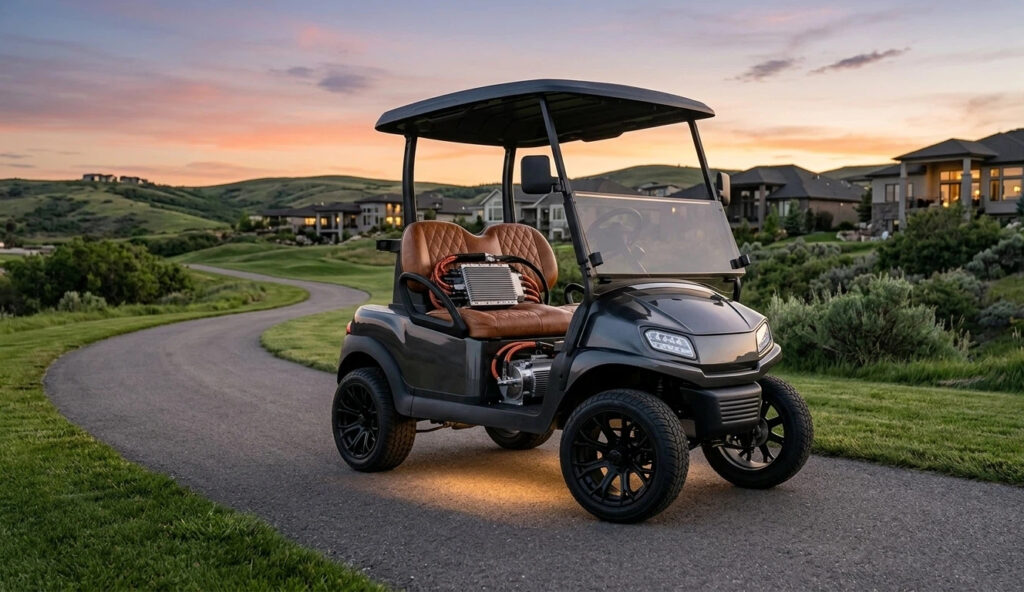
Direct-from-manufacturer sourcing is where this global shift becomes especially practical. When a buyer works through a traditional golf cart store or dealership chain, markup layers accumulate and customization options shrink. Sourcing directly from the factory changes that equation entirely. Custom utility configurations — cargo beds, passenger layouts, specialized suspension — can be specified upfront without aftermarket retrofitting and the reliability headaches it often creates.
“Eliminating aftermarket uncertainty starts at the source — when the vehicle is engineered and built to spec from day one, operators inherit far fewer problems down the road.”
In practice, this matters enormously for fleet reliability. Standardized components, factory warranties, and consistent build quality reduce the unpredictable maintenance cycles that plague mixed-sourcing strategies.
Buyers considering street-legal configurations should also note that manufacturing compliance varies — understanding how carts meet LSV standards before purchase prevents costly surprises later.
Still have questions about range, hill performance, or lifespan? The next section addresses the most common uncertainties buyers face head-on.
Frequently Asked Questions About Electric Mobility
These are the questions buyers, fleet managers, and community planners ask most often before committing to electric utility vehicles. Here are straightforward, data-backed answers.
How long does a single charge last? With a lithium-ion battery pack, most modern electric carts deliver a 50–70 mile range on a single charge. Real-world range depends on terrain, payload, and speed, but that window comfortably covers a full shift for the majority of resort, campus, and industrial applications. Lead-acid models typically fall well short of that mark.
Can electric carts handle steep hills? Yes. Torque delivery from electric motors is actually better suited to inclines than combustion alternatives. Lighter lithium battery systems reduce overall vehicle weight, which directly eases the load on the motor and suspension — a point worth reviewing when comparing 2026 pricing and battery options across models.
What is the lifespan of an electric golf cart? Lithium-powered models routinely reach 8–12 years of reliable service. That longevity is a core reason the total cost of ownership math — explored in earlier sections — tilts so heavily in favor of electric over time.
Are electric carts street legal? It depends. A cart must meet Low-Speed Vehicle (LSV) certification standards to operate legally on public roads. Requirements vary by state, and factors like mirrors, turn signals, and seatbelts all matter. If street use is part of your plan, understanding what makes a cart road-legal in your specific state is an essential first step.
The bottom line: electric mobility has matured far beyond the fairway. Whether your priority is cutting operating costs, reducing emissions, or scaling a community transport network, today’s electric carts deliver the performance, range, and durability to get the job done.
Key Takeaways
- Acceleration improvement: Switching to lithium reduces overall cart weight enough to deliver a 15–22% increase in acceleration, making hill climbing noticeably smoother and more reliable
- Consistent power delivery: Unlike lead-acid batteries that fade as charge depletes, lithium systems maintain voltage stability throughout the entire discharge cycle
- $2.1 billion in 2024 to $3.0 billion by 2030
- Electric isn’t just the cleaner option—it’s now the smarter operational choice.
- durability, turn radius, and charging efficiency