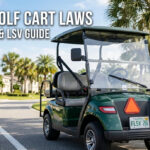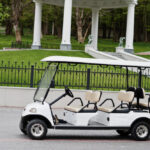
For residents of Florida, especially within premier retirement communities like The Villages, the transition from a standard golf cart to a Low-Speed Vehicle (LSV) is a significant lifestyle upgrade. However, this upgrade comes with a complex set of legal obligations. The most frequent stumbling block for owners is understanding the strict Florida LSV insurance requirements that separate these street-legal machines from traditional off-road carts.
In Florida, an LSV is not just a “fast golf cart”—it is a four-wheeled motor vehicle capable of speeds between 20 and 25 mph. Because they are permitted on public roads with speed limits up to 35 mph, the State of Florida treats them with the same insurance gravity as a full-sized sedan.
Table of Contents
The Legal Foundation of LSV Status
To understand Florida LSV insurance requirements, one must first look at the classification provided by the Florida Highway Safety and Motor Vehicles (FLHSMV). According to Florida Statute 316.2122, an LSV must be titled, registered, and insured before it ever touches a public road.
Unlike standard golf carts, which are largely unregulated at the state level regarding insurance, an LSV must have a 17-digit VIN. This VIN is the key to unlocking your registration, but you cannot obtain a license plate without proof of specific insurance coverage that meets the state’s high-risk threshold.
Official Resource: FLHSMV Low Speed Vehicles – Official Guidelines
The PIP and PDL Mandate
The core of Florida LSV insurance requirements revolves around two specific types of coverage: Personal Injury Protection (PIP) and Property Damage Liability (PDL).
Many new owners ask: “Do I need PIP insurance for a street legal golf cart in Florida?” The answer is a firm yes. Because Florida is a “no-fault” state, the law requires:
- $10,000 in PIP: This covers your medical expenses regardless of who caused the accident.
- $10,000 in PDL: This covers damage you cause to someone else’s property.
Failure to maintain this coverage doesn’t just result in a ticket; it can lead to the suspension of your driver’s license, even if you weren’t driving your primary car at the time.
Navigating The Villages: Tunnels, Bridges, and Compliance
Nowhere in the world is LSV culture more prominent than in The Villages. With its intricate network of golf cart tunnels and specialized bridges, the community is a haven for LSV drivers. However, Florida LSV insurance requirements remain a hot topic here due to the mix of multi-modal paths and public streets.
While you can drive a standard cart through a tunnel without a plate, the moment you cross onto a public road to reach a shopping plaza, your vehicle must be a fully compliant LSV. For the senior demographic in these communities, age can sometimes influence insurance premiums, making it vital to shop for specialized carriers that understand Florida LSV insurance requirements for retirees.
Florida Golf Cart vs LSV Laws: Know the Difference
A common mistake is assuming that “street-legal” modifications (like adding headlights) automatically turn a golf cart into an LSV. Under Florida LSV insurance requirements, the vehicle must be manufactured to meet Federal Motor Vehicle Safety Standards (FMVSS).
Key safety features required for insurance eligibility include:
- Three-point seat belts
- Windshield with wipers
- Internal and external mirrors
- Reflectors and parking brakes
Without these features, no reputable Florida insurer will issue the PIP policy required for registration.
Legal Reference: Florida Statutes Section 316.2122 – Operation of LSVs
Street Legal Golf Cart Registration FL: Step-by-Step
Once you have satisfied the Florida LSV insurance requirements, the registration process is relatively straightforward but rigid. You must visit your local County Tax Collector’s office with:
1.Proof of Florida insurance (PIP/PDL)
2.The vehicle’s Title or Manufacturer’s Certificate of Origin (MCO)
3.Form HSMV 82040 (Application for Title)
4.Payment for initial registration and plate fees
Remember, the state is extremely strict about the “effective date” of your insurance. Your policy must be active the day you apply for your tag.
The Cost of Non-Compliance
Ignoring Florida LSV insurance requirements is a gamble with high stakes. If you are caught operating an LSV on a public road without PIP and PDL, the FLHSMV has the authority to seize your tags and suspend your driving privileges.
In a community like The Villages, where your LSV is your primary mode of transportation for social activities, losing your “carting” privileges can be a major disruption. Furthermore, in the event of an accident, you would be personally liable for $10,000+ in medical and property damages.
Strategic Planning for LSV Owners
To balance the cost of Florida LSV insurance requirements, many owners bundle their LSV policy with their primary homeowners or auto insurance. However, always verify that the “LSV endorsement” actually provides the state-mandated PIP coverage. Standard “golf cart additives” on a homeowners policy usually do not satisfy the Florida LSV insurance requirements for road-legal registration.
Summary of Legal Obligations
Meeting the Florida LSV insurance requirements is the price of entry for the convenience of street-legal travel. Whether you are navigating the bridges of The Villages or the coastal roads of Jupiter, compliance ensures your safety and your legal standing.
By strictly following the Florida LSV insurance requirements, you protect your investment, your health, and your freedom to roam the Sunshine State in your favorite low-speed vehicle.
Looking to Make Your Cart Street Legal?
Navigating Florida LSV insurance requirements doesn’t have to be a headache. Whether you are a new resident in The Villages or looking to upgrade your current ride, getting the right legal setup is crucial.
👉 [Contact Our Compliance Experts Today] for a free consultation on LSV registration, insurance sourcing, and street-legal conversions. Let’s get you on the road safely and legally.
FAQ
Is Q345 equivalent to S355 for LSV frames?
While both are high-strength steels, LSV manufacturers usually prefer S355 or its equivalents for better weldability in lightweight chassis.
Do I need PIP insurance for a street legal golf cart in Florida?
Yes. If the vehicle is registered as an LSV with a license plate, $10,000 in PIP is mandatory.
Can I drive my LSV in The Villages tunnels?
Yes, LSVs are permitted in the tunnels, but they must follow all standard traffic patterns and yield to pedestrians.
What is the minimum insurance coverage for LSV in Florida?
You must have at least $10,000 in Personal Injury Protection (PIP) and $10,000 in Property Damage Liability (PDL).