Choosing the right utility vehicle is no longer a simple matter of preference. Whether you are commuting within a master-planned community like The Villages in Florida or managing heavy-duty tasks on a multi-acre farm, the Electric Golf Cart vs Gas Golf Cart debate sits at the heart of your decision.
In 2026, with the rapid maturation of lithium technology, this comparison has evolved from a simple power struggle into a sophisticated analysis of Return on Investment (ROI). This guide deconstructs the core differences through the lens of operational costs, maintenance cycles, and real-world application.
Table of Contents
Initial Investment and 5-Year Total Cost of Ownership (ROI)
Most buyers, when faced with the Electric Golf Cart vs Gas Golf Cart choice, focus primarily on the sticker price. Traditionally, gas-powered models offered a lower initial purchase cost. However, when evaluating the “Total Cost of Ownership (TCO)” over a 5-year period, the scales tip aggressively toward electric models.
According to the U.S. Department of Energy, electric drive systems are significantly more energy-efficient than internal combustion engines.
- Fuel & Energy: Charging a lithium-ion golf cart typically costs less than $1.00 per full cycle, whereas gas models are subject to volatile pump prices. Over five years, the “cost per mile” for an electric cart is roughly one-quarter that of its gas counterpart.
- Resale Value: As global demand for low-emission vehicles grows, the electric vs gas golf cart resale value has shifted. Modern lithium units now retain their value better than aging internal combustion models.
Performance Duel: Torque, Speed, and Terrain
When discussing the Electric Golf Cart vs Gas Golf Cart, raw performance remains a top priority for users in diverse environments.
- The Gas Advantage: Traditional engines still excel in the gas vs electric golf cart for hilly terrain category. Because they are not subject to battery voltage sag, gas carts maintain consistent power for long-distance hauling and high towing capacity.
- The Electric Revolution: Modern lithium-ion systems provide instant torque. Unlike traditional lead-acid batteries, lithium drives offer zero power lag when climbing, effectively rewriting the narrative that electric carts are “underpowered.”
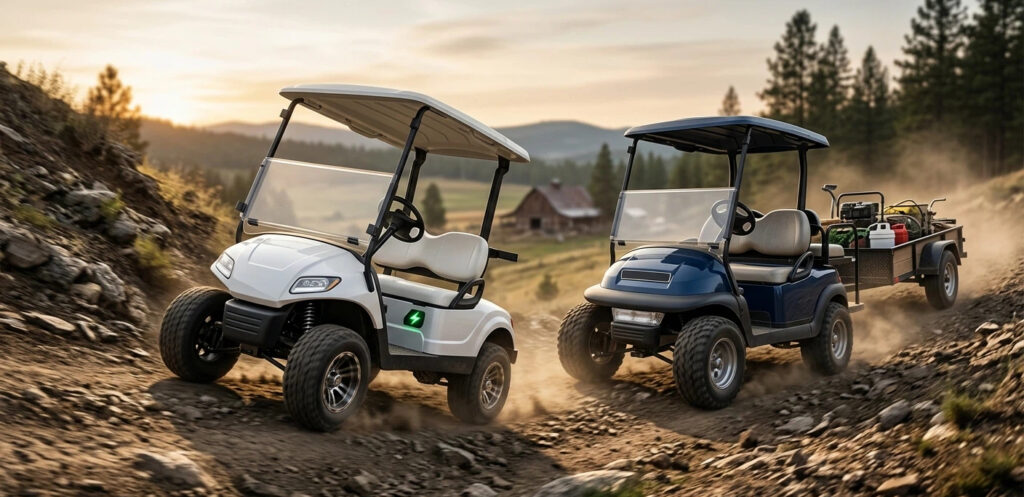
Core Specifications Comparison Chart
To facilitate a quick decision, we have summarized the Electric Golf Cart vs Gas Golf Cart core parameters below:
| Feature | Electric (Lithium-Ion) | Gas Powered (EFI) |
| Initial Purchase Price | High | Moderate |
| Maintenance Frequency | Minimal (Zero for Lithium) | Regular / High |
| Noise Level | Silent | Consistent Engine Noise |
| Cost Per Mile | Est. $0.02 – $0.04 | Est. $0.12 – $0.18 |
| Best Use Case | Neighborhoods, Golf Courses | Farms, Hunting, Off-Grid |
| Projected Lifespan | 10+ Years (Battery) | 10-15 Years (Engine) |
Maintenance: Saving Money vs. Saving Time
The maintenance landscape is where the Electric Golf Cart vs Gas Golf Cart divide is most apparent.
The Gas Maintenance Burden:
Owners must manage complex mechanical upkeep, including regular oil changes, spark plug replacements, air filter cleaning, and drive belt inspections. These maintenance cost comparisons reveal that gas owners often spend $200–$500 annually on labor and parts.
The Electric Logic:
- Lead-Acid: Requires distilled water refilling and terminal cleaning.
- Lithium-Ion: Virtually zero maintenance. While the upfront cost is higher, it eliminates the need for an expensive battery replacement vs gas engine overhaul.
Case-Specific Recommendations
Deciding between an Electric Golf Cart vs Gas Golf Cart depends heavily on your lifestyle and geography.
- Community Living: If you reside in a 55+ community that requires quiet golf carts for neighborhoods, electric is the only logical choice. They produce zero emissions and operate silently during late-night hours.
- Commercial & Agricultural: In the context of gas vs electric golf cart for multi-acre farm work, gas models remain superior due to their ability to be refueled instantly, bypassing the charging downtime required by electric fleets.
Sustainability and Environmental Impact
Beyond financial metrics, environmental impact is a heavy factor in the Electric Golf Cart vs Gas Golf Cart comparison. Electric carts offer zero-emission operation, making them ideal for ecologically sensitive resorts.
However, one must account for the golf cart battery lifespan. The recycling of lithium batteries is a major focus for industry sustainability.
FAQ
How long do electric golf cart batteries last vs gas engines?
Lead-acid batteries last 4–6 years; lithium-ion lasts 10+ years. Gas engines can last 15 years but require frequent overhauls to maintain efficiency.
Is an electric golf cart cheaper to maintain than gas?
Yes. Electric carts have significantly fewer moving parts, eliminating oil changes and most mechanical repairs.
Is the extra cost of a lithium golf cart worth it?
Absolutely. When you factor in the total cost of ownership gas vs electric golf cart over 5 years, lithium offers the highest ROI through zero maintenance and long life.