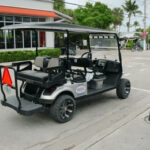
Street legal golf cart requirements are becoming an increasingly important topic as golf carts expand beyond golf courses into residential communities, resorts, campuses, and short-distance transportation zones. Many owners purchase a golf cart assuming it can be driven on nearby streets, only to discover that road use depends on specific legal and safety standards.
Table of Contents
Core concept: what is your vehicle? (and why that determines street use)
Local regulators usually split small utility vehicles into two buckets: “golf cart” and “low-speed vehicle / neighborhood electric vehicle (LSV/NEV).” Knowing which bucket your machine fits is the first step in understanding street legal golf cart requirements.
- Golf cart: typically designed for course use, often capped at about 15 mph, limited seating and lightweight. These are often allowed on private property and, in very limited cases, on nearby public roads or crossings by local ordinance.
- LSV / NEV: factory or properly converted vehicles that meet Federal Motor Vehicle Safety Standards for LSVs (FMVSS 500) — designed to reach 20–25 mph and fit a defined safety equipment list (lights, mirrors, windshield, seat belts, VIN, etc.). States then set where LSVs can operate.
Why this matters: most jurisdictions only allow LSVs (or properly equipped and registered carts) onto public roads, so if your cart is a plain 15-mph golf cart you usually must either limit use to private property or convert/register it as an LSV and meet the street legal golf cart requirements.
Quick global snapshot: the common four pillars of street legal rules
Across regions the same four criteria keep reappearing — structure your plan around these:
1.speed classification / road speed caps
2.mandatory road-safety equipment (lights, signals, mirrors, seat belts, VIN)
3.registration & insurance (title, plate, proof of insurance)
4.driver licensing and local route limitations
Putting those together is the quickest way to judge whether your cart can be driven on a particular road and which street legal golf cart requirements apply.
Regional deep dive — highlights and practical tips
United States: wide variation by state
U.S. rules are state-driven. Federal FMVSS 500 sets the safety baseline for LSVs but states decide where to allow them and how to title/register them. That’s why you’ll see different rules city-to-city even inside the same state.
California is strict and precise: the state distinguishes golf carts (small, ≤15 mph, limited use) from NEVs/LSVs (20–25 mph, FMVSS compliance). Many cities create NEV/“golf cart zone” routes; otherwise you must register an LSV/NEV, carry insurance and meet equipment rules. Local ordinances may add requirements. (See local DMV/City code for exact procedures.)
Florida
Florida allows municipal/county designation of roads for golf carts; equipment rules and hours (sunrise to sunset unless equipped for night) apply, and driver-ID requirements exist. Counties or cities must post signage to permit cart use on public roads. If you plan road use in Florida, check your county or city code (e.g., community holiday exceptions exist in some areas).
Texas
Canada (provincial — example: British Columbia)
In Canada, provinces set rules. For example, British Columbia has a “neighbourhood golf cart” regime that lets designated municipalities permit golf carts on specific routes and requires permits or registration in some cases. Provinces vary widely — always check the provincial motor vehicle regs and municipal bylaws.
Australia
Australian rules vary by state and local councils. Some retirement communities and islands operate under specific local approvals; others treat these vehicles as off-road/utility vehicles requiring registration for certain uses. Always check the state roads authority and local council for permitted routes and registration rules.
street legal golf cart requirements — Europe overview
EU-wide baseline: L-category (L6e / L7e) and type approval
At EU level, Regulation (EU) No. 168/2013 governs “L-category” vehicles (including light and heavy quadricycles L6e and L7e). Vehicles intended for public roads normally need the appropriate type-approval (or an individual approval) to be registered and insured. In practice, many road-legal small electric vehicles used like neighbourhood buggies are approved under L6e/L7e rules, which set limits for speed, power and mass and require conformity documentation (Certificate of Conformity).
Country examples — practical notes
- United Kingdom: to register a golf-style vehicle for public roads you usually need to classify it as a light quadricycle (L6e) or obtain an Individual Vehicle Approval (IVA). Required safety items (headlights, indicators, mirrors, windscreen, seat belts, speedometer, VIN and so on) are typically checked by DVSA/DVLA during IVA/registration.
- Germany / Austria: Germany and nearby countries follow the EU L-category framework strictly — a cart without EU type-approval will generally be treated as a non-road vehicle unless it is individually approved and fitted with the required equipment. Austria’s specialist dealers note that only vehicles with EU type approval (L6e/L7e) are freely permitted on public roads.
- France: French practice is similar — standard golf buggies for course use are not road-legal; driving a non-registered buggy on department roads can result in fines, because public roads require registration and number plates for vehicles used on the highway network.
- Spain / Italy (brief): Spain and Italy follow the same EU L-category approach — you will typically need type-approval or an official individual approval and national registration; local municipalities sometimes authorise slow-speed vehicles on specific lanes or within limited zones (coastal resorts, islands, gated communities).
Practical takeaway for Europe: aim for an EU type-approved L6e/L7e vehicle (or an IVA when available). Even after approval, check municipal bylaws — some towns explicitly ban non-standard buggies from certain public roads, while others publish designated “golf cart / quadricycle” routes.
Basic Requirements for a Street-Legal Golf Cart
In most countries or states, converting a golf cart into a street-legal vehicle requires adding specific safety equipment.
The following table summarizes common requirements.
| Required Equipment | Purpose |
|---|---|
| Headlights | Visibility during low-light conditions |
| Tail lights & brake lights | Signal braking and vehicle presence |
| Turn signals | Communicate turning intentions |
| Rearview mirrors | Improve driver awareness |
| Windshield | Protect driver and passengers |
| Seat belts | Passenger safety |
| Horn | Audible warning signal |
| Reflectors | Improve night visibility |
| Vehicle Identification Number (VIN) | Required for registration |
The following content is intended to provide examples of how to legalize golf carts in California.
Key Legal Standards
Understanding the requirements begins with distinguishing between a traditional golf cart and a road-approved low-speed vehicle (LSV). street legal golf cart requirements provide the criteria regulators use to classify vehicles for road use.
A typical golf cart is designed for private property and golf course use. These vehicles usually have lower top speeds and lack the safety components required for road operation.
An LSV, on the other hand, is built to meet federal or regional transportation safety standards and can legally operate on certain public roads. In the United States, these vehicles must comply with Federal Motor Vehicle Safety Standard (FMVSS) 500, which informs these technical requirements at the federal level.
Generally, an LSV must:
- Reach speeds between 20–25 mph (32–40 km/h)
- Include required safety equipment
- Operate on roads with speed limits typically under 35 mph
Meeting these criteria is the foundation of most street legal golf cart requirements worldwide.
How to Make a Golf Cart Street Legal
Owners who want to meet these standards usually follow a structured process.
Step 1 — install required equipment: lights, mirrors, signals, seat belts.
Step 2 — verify speed capability.
Step 3 — obtain a VIN if needed.
Step 4 — pass inspection with your local transport authority.
Step 5 — register and insure the vehicle.
These practical steps align directly with the most common street legal golf cart requirements and help streamline approval.
Benefits
Vehicles that meet street legal golf cart requirements offer lower operating costs, environmental benefits, and practical short-distance mobility for communities and businesses.
Conclusion
If you plan to drive a golf cart on public roads, understanding the local street legal golf cart requirements is the first step to ensuring your vehicle meets safety standards and registration rules.Before purchasing or modifying a vehicle, always check local regulations to ensure compliance with street legal golf cart requirements.
FAQ
Can golf carts legally drive on public roads?
Yes, if they meet local street legal golf cart requirements and are registered.
What speed must a street-legal golf cart reach?
Most jurisdictions require speeds between 20 and 25 mph.
Do street-legal golf carts need license plates?
Often yes; registration may include issuing a plate and insurance.
Are golf carts legal in Europe?
Yes, when classified under L6e or L7e and approved according to EU and national rules.