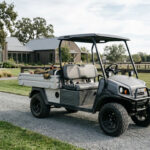
For the modern family, a golf cart isn’t just for 18 holes anymore—it is a neighborhood SUV. We use them to haul groceries, drop kids off at practice, and cruise hilly community paths. But here is the terrifying reality: while we have upgraded these carts with high-speed motors and heavy lithium batteries, many are still relying on 1970s-era mechanical drum technology to stop.
If you’ve ever felt that “sinking feeling” as your brake pedal hits the floor while descending a steep driveway with a full load, you know that safety isn’t guaranteed. Upgrading to Golf Cart Disc Brakes is the single most important investment you can make for your vehicle. In this guide, we’ll break down why hydraulic braking systems are the only way to ensure your family’s LSV (Low-Speed Vehicle) stays under control when it matters most.
Table of Contents
Why Mechanical Drums Fail Modern Family Carts
Standard golf carts traditionally come equipped with mechanical drum brakes. In this system, a steel cable pulls a set of shoes against a drum. On a flat golf course at 12 mph, this is perfectly fine. However, the modern “Street Legal” cart is a different beast entirely.
When you add a rear-seat kit and four passengers, you are often pushing the vehicle’s weight toward 1,500 lbs. When that weight meets a 10-degree incline, mechanical cables stretch and drums overheat. This leads to “brake fade”—a dangerous condition where the friction material loses its grip due to thermal overload. Transitioning to Golf Cart Disc Brakes eliminates this cable-stretch variable entirely, replacing it with consistent, fluid-driven pressure.
According to the safety engineering guidelines from the International Organization for Standardization (ISO), braking systems for small passenger vehicles must maintain performance even under repeated high-load cycles. You can explore the technical requirements for small vehicle safety at the ISO Standards Portal.
The 40% Advantage: Real-World Performance of Golf Cart Disc Brakes
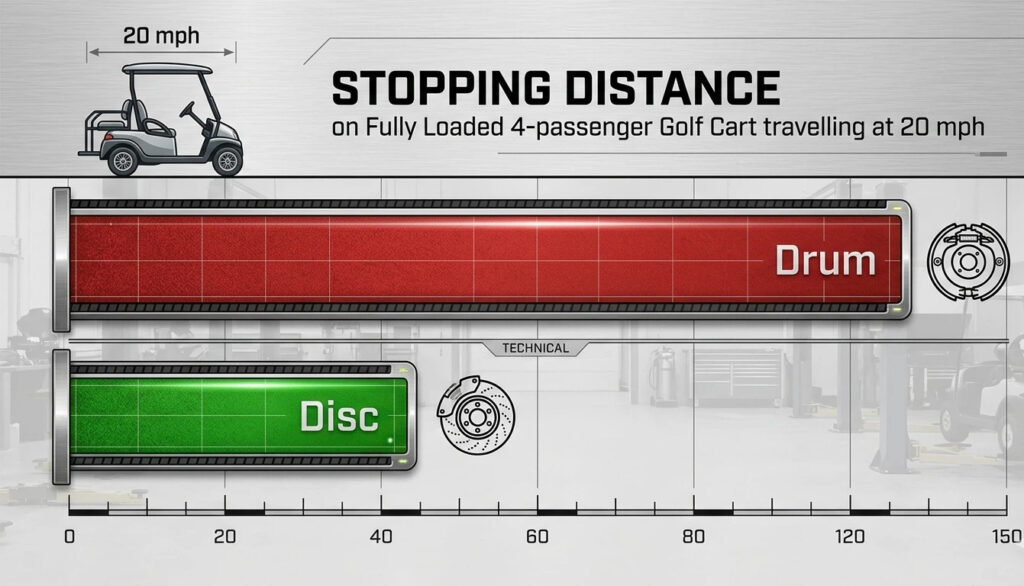
The physics of stopping are simple: the faster you go, the more heat you generate. In a direct comparison of drum brakes vs disc brakes for street legal carts, the disc system offers roughly 40% better stopping power in emergency situations.
Because the disc (rotor) is exposed to the air, it dissipates heat instantly. This “open” design prevents the heat-soak that plagues drum systems. Furthermore, hydraulic braking systems provide a “linear” feel. This means the harder you press the pedal, the more predictably the cart slows down. For families with younger drivers or seniors, installing Golf Cart Disc Brakes means this predictability is the difference between a controlled stop and a panicked skid.
Compare Disc Brakes vs Drum Brakes
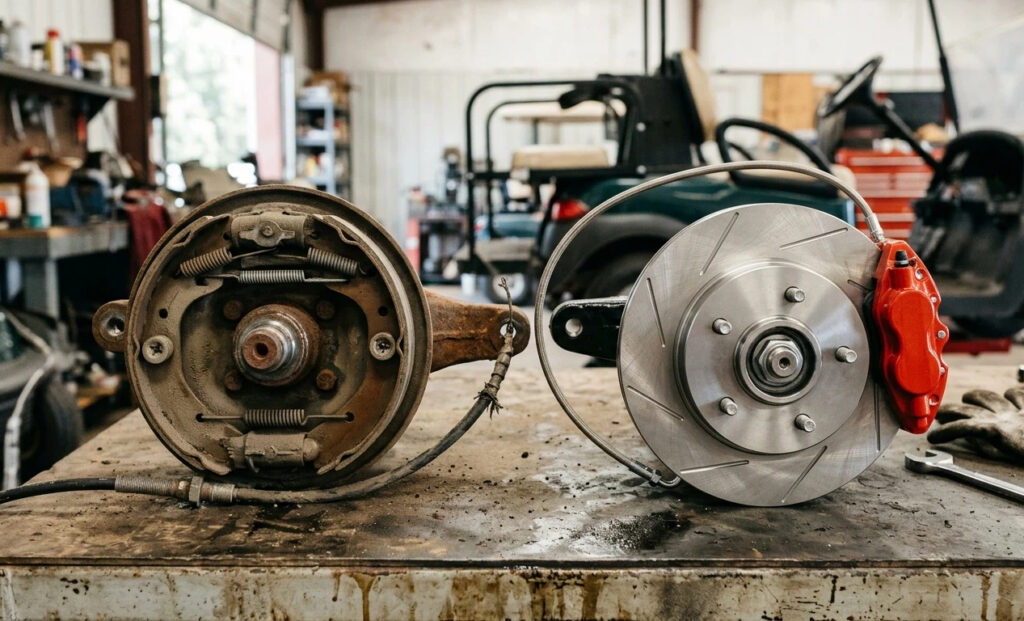
When we look closely to compare disc brakes vs drum brakes, the difference isn’t just in the parts—it’s in the physics of deceleration. Traditional drum brakes are a “closed” system. They rely on internal shoes pushing outward against a rotating cylinder. While simple, this design is the primary culprit behind the “spongy” pedal feel many owners report during long summer drives.
To help you decide if a golf cart disc brake conversion is necessary for your specific terrain, here is a technical breakdown of how these two technologies stack up in real-world LSV applications:
| Feature | Mechanical Drum Brakes | Hydraulic Golf Cart Disc Brakes |
| Heat Dissipation | Poor (Trapped inside the drum) | Superior (Open-air cooling) |
| Wet Weather Response | Delayed (Water traps inside) | Instant (Rotors shed water) |
| Maintenance Need | Constant manual adjustment | Self-adjusting / Low maintenance |
| Stopping Power | Moderate (Fades under load) | High (Consistent 40% shorter) |
| Best For | Flat golf courses only | Hilly roads, Families, & Street use |
The “Brake Fade” Factor
The most critical reason to choose Golf Cart Disc Brakes over drums is the elimination of thermal fade. In a drum system, heat causes the metal drum to expand away from the shoes, requiring you to press the pedal deeper and deeper just to maintain speed control.
Meeting Brake Compliance for Florida and Texas LSVs
Safety is the primary goal, but legal compliance is a close second. If you are converting a cart to be street-legal, most jurisdictions require the vehicle to pass a rigorous safety inspection.
In high-growth LSV markets, documentation is key. For instance, following the strict Florida golf cart laws
requires specific lighting and braking capabilities to qualify as a Low-Speed Vehicle. Similarly, navigating Texas golf cart city guides reveals that local police often look for upgraded safety features when issuing permits for neighborhood use. Upgrading to Golf Cart Disc Brakes ensures you pass these inspections on the first try, proving your vehicle is fit for public roads.
What to Expect in a Golf Cart Disc Brake Conversion
Can you handle a golf cart disc brake conversion in your own garage? The answer is yes—if you have the right tools. Most modern kits are “bolt-on,” designed to fit major brands like Club Car, EZGO, and Yamaha without welding. High-performance Golf Cart Disc Brakes are now more accessible than ever for the home mechanic.
A standard conversion kit typically includes:
- Pre-charged Hydraulic Lines: To minimize the mess of fluid handling.
- Dual-Piston Calipers: For maximum clamping force.
- Heavy-Duty Rotors: Often slotted or drilled for better cooling.
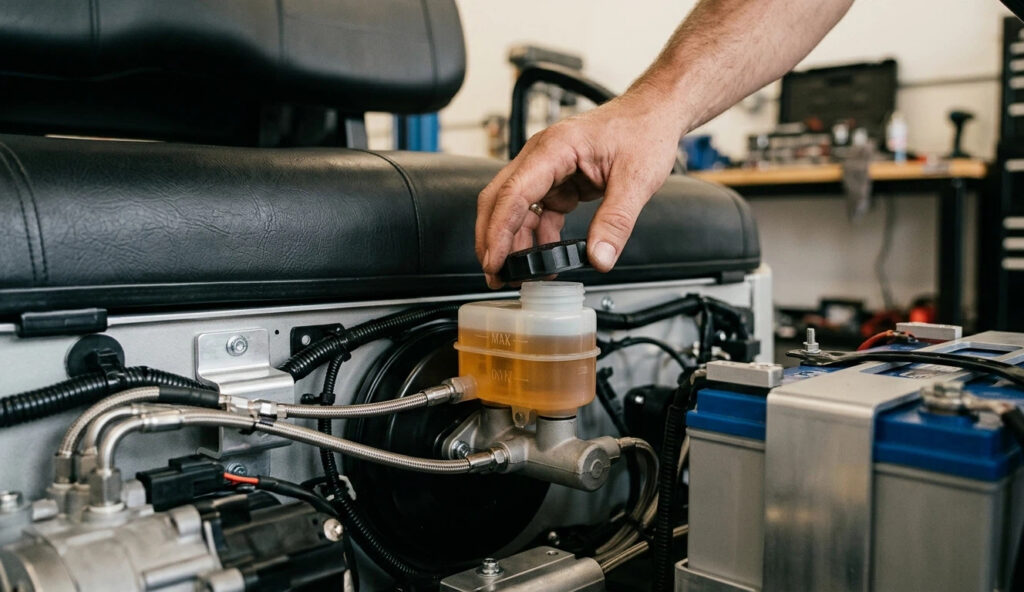
- Master Cylinder: The “heart” of the hydraulic braking systems.
The biggest challenge for DIYers is “bleeding” the air out of the lines. Even a tiny bubble of air can make the pedal feel spongy and unsafe. If you aren’t comfortable with high-pressure Golf Cart Disc Brakes, this is one area where paying a professional is a wise investment in your family’s safety.
Solving the Downhill Brake Failure
The most common “near-miss” reported by our readers involves descending a steep bridge or driveway. Mechanical brakes often “glaze” over when held at a constant pressure during a long descent.
Quality Golf Cart Disc Brakes use automotive-grade friction materials that thrive under pressure. Because the system is self-adjusting, the pads stay at the optimal distance from the rotor, ensuring that the very first inch of pedal travel results in immediate deceleration. For parents hauling a cart full of kids and beach gear, the instant response of Golf Cart Disc Brakes is non-negotiable.
Maintenance for Golf Cart Brakes
Even the most expensive hydraulic braking systems will fail if neglected. However, the maintenance for Golf Cart Disc Brakes is generally simpler than the constant adjusting required by drums.
- Fluid Inspection: Check the master cylinder every 6 months. The fluid should be honey-colored.
- Pad Wear: Most Golf Cart Disc Brakes allow you to see the pad thickness without removing the wheel. Replace them when the friction material is less than 1/8th of an inch.
- Rotor Integrity: Look for “grooving” or discoloration on the rotors.
For deeper technical insights into hydraulic fluid standards and safety ratings, the Society of Automotive Engineers (SAE) provides the industry-standard benchmarks used for the Maintenance for golf cart brakes.
Final Verdict
If your cart goes faster than 15 mph, or if you carry more than two people, the factory drum brakes are an insurance claim waiting to happen. The transition to Golf Cart Disc Brakes is the most significant safety milestone in your vehicle’s life cycle.
Whether you are building a custom LSV to meet Florida or Texas regulations, or you simply want to ensure you stop at the bottom of a steep neighborhood hill, the choice is clear. Don’t wait for a brake failure to tell you it’s time for an upgrade. Switch to high-performance Golf Cart Disc Brakes and give your family the protection they deserve.
FAQ
Why does my brake pedal feel “mushy” after my golf cart disc brake conversion?
This is almost always caused by air in the lines. Hydraulic braking systems must be perfectly sealed to function.
Is it okay to only upgrade the front brakes?
Most carts are rear-wheel drive. While a rear Golf Cart Disc Brakes upgrade provides the most benefit, 4-wheel kits are the ultimate choice for heavy 6-passenger carts.
Do disc brakes work better in the rain?
Absolutely. Drum brakes can trap water inside. Golf Cart Disc Brakes spin off water almost instantly, providing much better performance for drum brakes vs disc brakes for street legal carts.
Are Golf Cart Disc Brakes more expensive to maintain?
No. While the initial kit costs more, the long-term Maintenance for golf cart brakes is lower because they are self-adjusting and have fewer moving parts than mechanical drums.